Privacy in Always-On AI: The Tradeoffs Worth Having Out Loud
An AI that is always on is either a superpower or a surveillance device
By The Aware Engineering Team
# Privacy in Always-On AI: The Tradeoffs Worth Having Out Loud
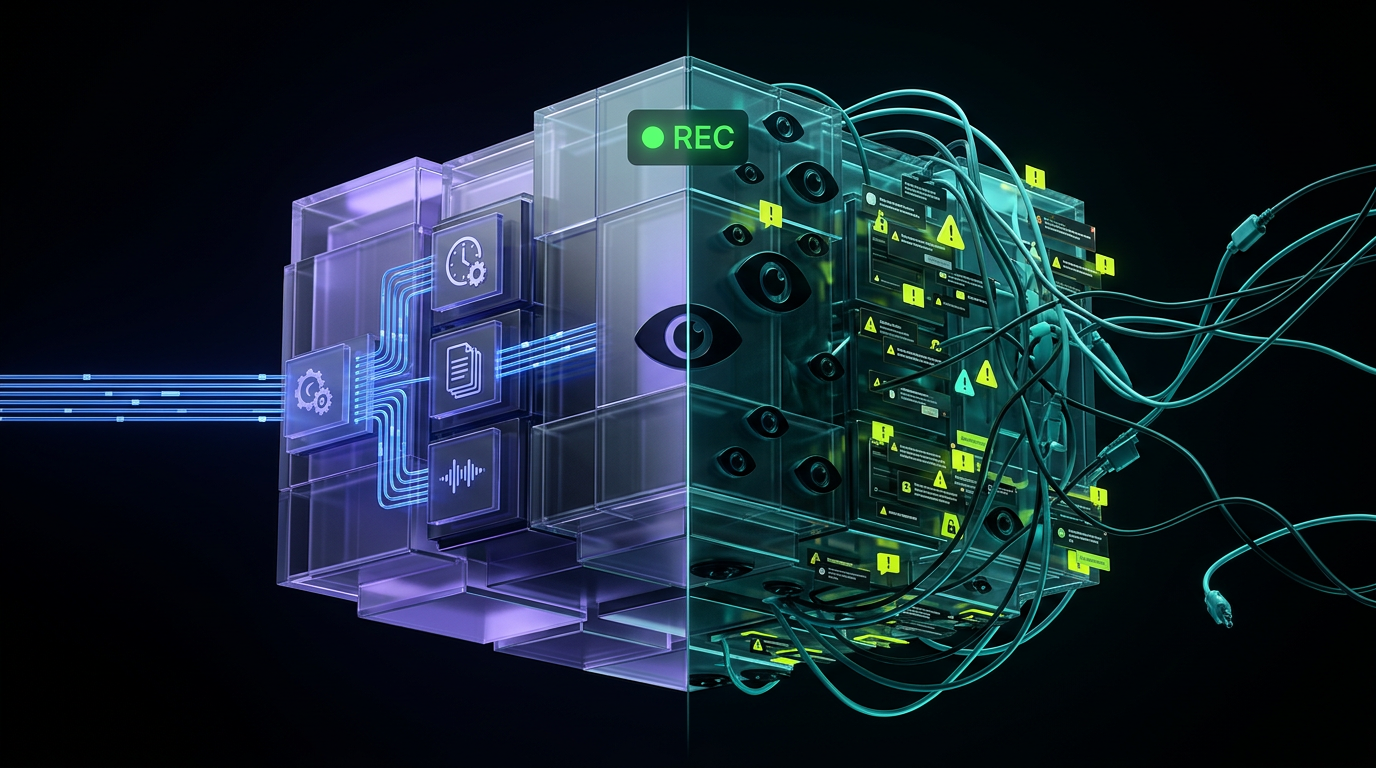
An AI that is always on is either a superpower or a surveillance device.
The difference isn’t technology; it’s intent. As we move from actively prompting chatbots to passively using ambient AI, the question of **always on ai privacy** shifts from a theoretical concern to a fundamental requirement. The promise is a second brain that remembers everything for you. The risk is a corporate ledger that remembers everything about you.
## The 'always-on' promise is the problem
The appeal of an ambient, always-on AI is its effortlessness. It’s the idea of an intelligence layer that captures the context of your work and conversations without you needing to press a record button or manually take notes. It sees what you see, hears what you say, and synthesizes it all into a searchable, personal memory.
This is an undeniable force multiplier for anyone who trades in information. It promises an end to forgotten action items, lost URLs, and the vague memory of a brilliant idea you had on a call three Tuesdays ago.
The problem is the price of admission. To deliver on this promise, the system requires persistent access to your microphone, your screen, or both. This is the explicit bargain, and it’s the source of all valid **ai privacy concerns**. There is no way around this access requirement. The only thing that matters is what happens next.
## Where the data goes matters most
The moment your data is captured, it begins a journey. Most AI companies are deliberately vague about the itinerary. In a private system, this journey should be a short, local round trip. In most others, it’s a one-way flight to a server you don’t control.
### The Cloud Default
The standard playbook for AI services is to send your data—audio streams, screen captures, and all—to the cloud for processing. It’s computationally cheaper and technically simpler for the company. It’s also a privacy dumpster fire.
Once your data is on third-party servers, you’ve lost control. It can be accessed by company employees for "quality control," become a target for data breaches, and be subpoenaed by law enforcement. Worst of all, it’s often fed directly into the machine, your private conversations and proprietary data used to train the company's next commercial AI model. Your work becomes their asset.
### The On-Device Alternative
A truly **private ai assistant** inverts this model. The heavy lifting—transcription, entity recognition, and initial processing—happens directly on your machine. The raw data never leaves your device. It is processed locally and then immediately discarded.
This is harder to build. It requires efficient models and thoughtful engineering. But it is the only way to architect a system that respects user privacy from the ground up. The only data that might ever leave your device are anonymized, context-stripped queries to a large language model for summarization or analysis—never the source recording itself.
## An honest look at always on ai privacy
Let's be direct: there is no such thing as absolute, zero-risk security. Any piece of software has a potential attack surface. The goal of a privacy-first architecture isn’t to achieve an impossible state of perfection, but to radically minimize risk and align the incentives of the user and the provider.
> Privacy isn't a feature you bolt on after a data breach. It's a fundamental architectural choice you make on day one, and it dictates everything that follows.
A system serious about privacy isn't created by accident or with a pinky-promise. It is engineered with specific, non-negotiable principles.
1. **Local-First Processing.** The most sensitive data—raw audio and video—is processed on the user's device and never sent to any cloud server, ever. It's used and then it's gone.
2. **User-Controlled Storage.** The structured data that the AI creates (transcripts, summaries, notes) is owned by you. It should be stored in a way that the service provider cannot access, with clear paths for you to export or delete it all at any time.
3. **No Training on User Data.** An unbreakable, clearly stated policy that your data will never be used to train the company's AI models. Period. Your private context should not be a public resource.
4. **Transparent Policies.** The company must explain, in plain language, what data goes where and why. No 40-page terms of service documents written by a team of lawyers to obscure the truth.
If a provider can't give you a straight 'yes' to all four of these, they are not building for you. They are building with you as the raw material.
## The business model is the privacy model
If the service is free, your data is the product. This has been a truism of the internet for two decades, and it’s even more potent in the age of AI.
Companies offering "free" or impossibly cheap always-on AI are not charities. They are data operations. Their business model relies on achieving massive scale and leveraging the data that flows through their system—either by training proprietary models, selling aggregated insights, or simply amassing a data moat that makes their enterprise valuation untouchable. Their financial incentives are fundamentally opposed to your privacy.
The alternative is refreshingly simple: you pay a fair price for a service. A subscription model aligns the company's incentives with yours. Their goal is no longer to harvest your data but to build a tool so good that you happily continue paying for it. Their success is tied to your satisfaction and trust, not your exploitation.
## What to ask your AI provider
You have the right to be skeptical. The burden of proof is on the companies asking for access to your digital life, not on you. Before you install any always-on AI, ask these questions. If the answers are evasive, you have your final answer.
* Where is my raw data (like audio or screen recordings) processed? Is it on my device or your servers?
* Is any of my personal or professional data used to train your AI models?
* Can your employees access my data? If so, who and under what specific circumstances?
* What is your business model? Is it a subscription, or are you monetizing data?
* Can I easily export all of my data and permanently delete my account?
An AI provider who values **ai data privacy** will have clear, confident answers. An AI provider who doesn't will talk about encryption, compliance, and trust, all while avoiding the simple truths of their architecture.
Building a truly private, powerful AI layer is not a fantasy. It requires making hard choices early on—choosing the user over the dataset, control over convenience, and trust over scale-at-all-costs. The tradeoffs involved in **always on ai privacy** are significant, but the right path is creating a tool that serves its user, not a system that feeds on them.
At Aware, we made these choices from the start. Your data is processed locally, owned by you, and never used for training. It’s the private AI assistant we wanted for ourselves, so we built it for everyone who values their privacy as much as their productivity. See what an AI layer built on a foundation of trust feels like.