The Daily Briefing You Always Wanted (and Finally Get)
Most “daily briefings” are just a glorified to-do list you still have to write yourself
By The Aware AI Team
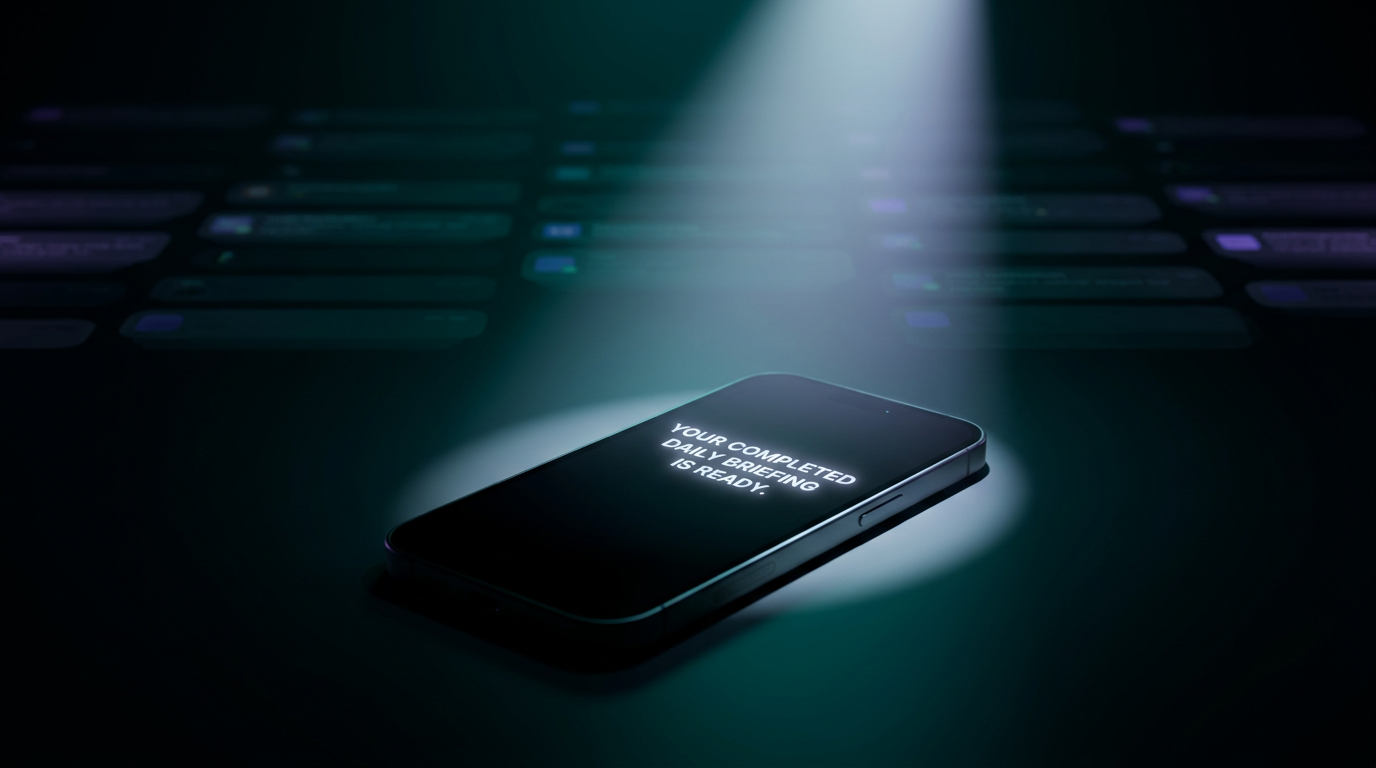
# The Daily Briefing You Always Wanted (and Finally Get)
Most “daily briefings” are just a glorified to-do list you still have to write yourself.
You wake up, grab your phone, and cycle through the same five apps, trying to piece together what matters for the day. It’s a reactive, fragmented process that feels more like a chore than a strategy. A proper **ai daily briefing** should do that work for you, preparing you for your day, not just reminding you of its existence. It needs to provide synthesis, not just another dashboard of disconnected information.
## What a daily briefing promises
The dream of a morning briefing is simple: a single, coherent view of your day that gives you leverage. You want to understand the landscape before you set foot in it. The problem is that the landscape is spread across a half-dozen different apps that don’t talk to each other.
To get a full picture, you’re forced to manually assemble your own intelligence report from a scattered list of sources:
* Your calendar for what’s scheduled.
* Your email for inbound requests and critical updates.
* Slack or Teams for the real-time internal chatter and fires.
* A project management tool like Asana or Jira for official task status.
* Perhaps a news feed for industry context.
Most products sold as a `morning briefing app` fail to deliver on the original promise. They are aggregators, not synthesizers. They simply give you another screen that puts your calendar next to your task list. This isn't helpful. It's just a slightly more organized version of the chaos you were already dealing with.
The core job isn't to see all your feeds in one place. It’s to understand what they mean when put together.
## The problem is synthesis, not access
You don’t need another app that shows you your email inbox next to your calendar. You can already do that by opening two tabs. The real work, the thing that actually saves you time and makes you more effective, is understanding the connections between the fragments.
That cryptic calendar invite from a new client? It’s probably related to that high-priority bug report that lit up a Slack channel late last night. The urgent email you need to read first? It’s from the person you’re meeting with at 10 AM, and it contains the document they expect you to have reviewed. Your brain is the only thing connecting these dots, and it’s an exhausting, manual process.
This is where traditional software hits a wall. Dashboards give you access, but they don’t provide intelligence. They show you data streams but offer zero interpretation.
> The goal isn't to start your day by staring at a dashboard. The goal is to start your day already knowing what matters.
An ambient AI layer works differently. It operates in the background, observing the natural flow of work across your existing tools. It’s not about aggregating feeds; it’s about understanding the relationships between the items within them. It finds the signal in the noise.
## How an ai daily briefing changes things
A true `daily brief ai` doesn’t just show you what’s happening. It tells you *why* it matters and what’s connected. It transforms your relationship with information from reactive consumption to proactive strategy. The entire function is to provide leverage.
### From raw data to actionable intelligence
Instead of a generic calendar entry, you get a contextualized summary. The system understands that a meeting isn't just a block of time; it's a culmination of previous conversations, documents, and decisions.
A typical calendar says: `10:00 AM - Sync with Sarah`.
An intelligent briefing says: `10:00 AM - Sync with Sarah on the Q3 proposal. Here is the latest draft she sent via email yesterday, and remember your team flagged a budget concern about it in the #marketing Slack channel.`
This isn't just convenient. It's a fundamental advantage. It allows you to walk into every interaction fully prepared, without spending 15 minutes beforehand scrambling for context.
### Prioritization without the guesswork
A good briefing is opinionated. It doesn't just show you 50 unread emails and 20 Slack notifications. It surfaces the three items that genuinely require your attention before your first meeting. It understands dependencies. It sees the email from your most important client that’s about to breach its SLA, or the direct question from your CEO buried in a thread that you might have otherwise missed.
This is what **prioritization based on intelligence** looks like. It’s not about flags you set yourself; it’s about the system understanding the implicit importance of communications based on sender, content, and context.
## What your morning routine could be
The frantic, multi-app scavenger hunt is a terrible way to start a day. It primes your brain for distraction and reaction, ensuring you begin on the back foot. An effective `ai morning routine` is built on the opposite principle: calm, focused clarity.
The "after" state is deceptively simple.
1. Wake up.
2. Receive a single, concise summary from *Aware*, delivered to you.
3. Instantly understand the 2-3 critical items and connections for your day: the looming deadline, the important conversation that needs to happen, the unresolved issue from yesterday.
4. Begin your work with proactive focus, not reactive anxiety.
This isn’t about adding a new tool to your morning checklist. It's about having a system that does the checking for you, presenting a finished strategic summary so you can get straight to the real work of thinking and deciding.
## It’s not about more information
The modern professional doesn't suffer from a lack of information. We suffer from a lack of high-quality filters. The value is not in seeing everything; the value is in being shown only the right things at the right time. An effective **ai daily briefing** is an editor, not an aggregator. It has taste. It cuts noise.
Let's be direct about the contrast.
**The Old Way:**
* Manually checking email, calendar, Slack, Asana, and more.
* Trying to hold a mental map of how a Slack conversation relates to a calendar event.
* Risking important context falling through the cracks of a busy inbox.
* Starting the day feeling behind and overwhelmed.
**The New Way:**
* Receiving one synthesized summary of what's important.
* Seeing the connections between people, projects, and conversations drawn for you.
* **Key context is automatically surfaced and prioritized.**
* Starting the day with clarity, control, and a distinct advantage.
Imagine a summary that doesn't just list your meetings but annotates them with relevant files and conversations from the past week. This isn't a hypothetical mock-up; it's how a true intelligence layer is supposed to function. It delivers answers, not just links to more data.
## This isn't some future state
This capability isn't a sci-fi concept or a theoretical future. It’s here. We built *Aware* because we, as founders and operators, were tired of the digital chaos that passes for a "morning routine" in modern work. We found ourselves spending the first hour of every day just catching up, not getting ahead.
We needed a tool that could digest the firehose of information for us and hand us the critical insights. We needed a system that understood our work, our priorities, and the web of connections between our projects and people. We couldn’t find one, so we built it.
The result is an **ai daily briefing** that actually prepares you for your day. It gives you leverage before you’ve even had your first cup of coffee. It’s the calm, intelligent partner you always wished you had to help you navigate the noise.
The promise of a daily briefing was always about gaining clarity and preparedness, not just staring at another list of tasks. With the right intelligence layer, that promise is finally met. You don't need more apps; you need more awareness.
Stop reading about it. [Try Aware free](https://stayaware.ai/trial/handled).