Ambient AI vs Chatbots: The Quiet Shift That's Already Happening
The world has another chatbot
By The Aware Engineering Team
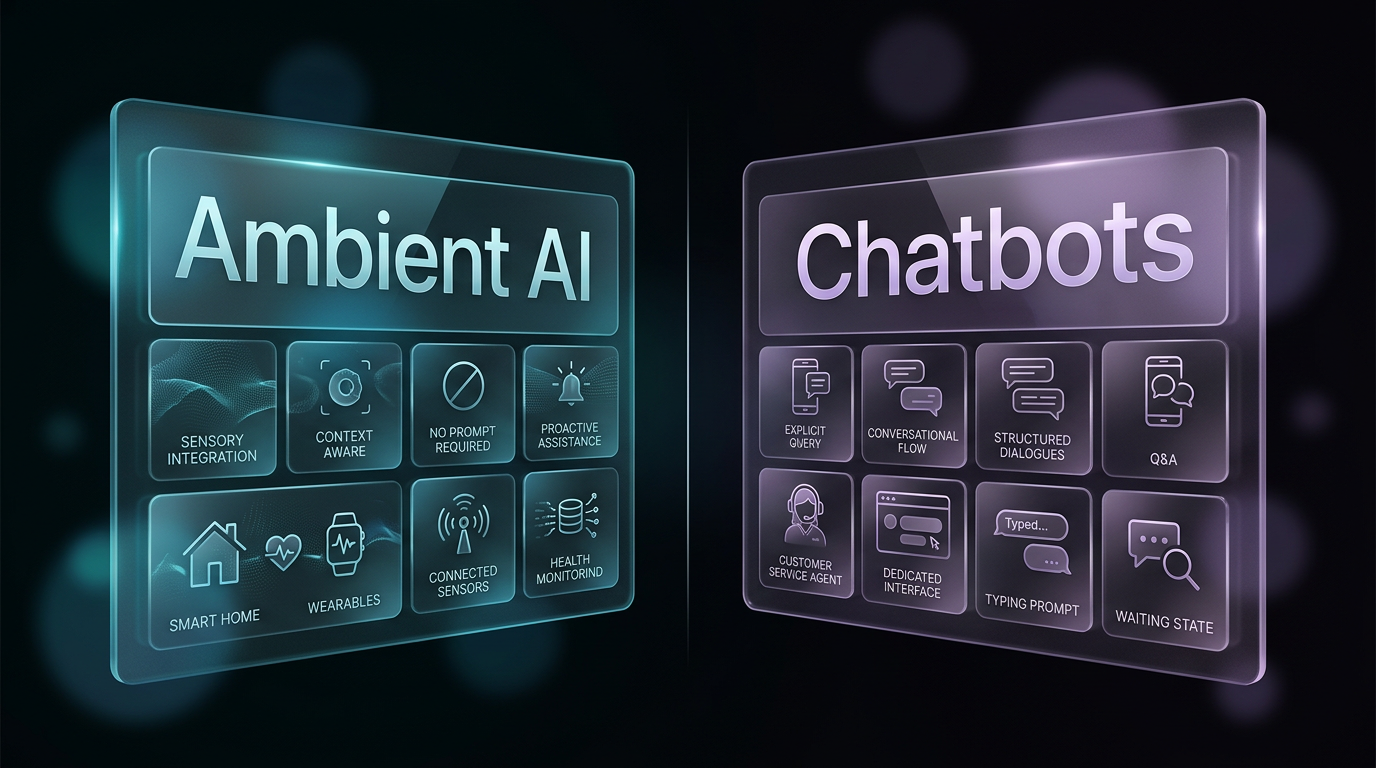
# Ambient AI vs Chatbots: The Quiet Shift That's Already Happening
The world has another chatbot.
It’s probably in your browser tab right now, a blinking cursor waiting for your next brilliant prompt. The hype cycle convinced everyone that the future of AI was a conversation. But the debate of **ambient ai vs chatbots** isn’t a debate about the future; it’s about a quiet shift that’s already making the chat window obsolete for real work.
## The tyranny of the blinking cursor
Chatbots are task-oriented. They sit there and wait for you to tell them what to do. This puts the burden entirely on you. You have to stop your work, switch contexts, formulate the perfect question, and then babysit the output.
It’s another item on your to-do list. It’s a tool you have to actively *operate*, like a lawnmower. You don’t get credit for mowing the lawn well, you just have a mown lawn—and you’re the one who had to do all the pushing. This is the fundamental flaw of the chatbot model: it presents itself as an assistant but acts like an intern on its first day, full of potential but requiring constant, explicit direction.
## From active commands to passive context
Ambient AI operates on a completely different principle. It doesn’t wait for you to command it. It observes, synthesizes, and anticipates. By integrating with the tools you already use—your calendar, your email, your meeting software—it gathers context passively and works in the background.
This is the difference between hiring an assistant and becoming one. A chatbot asks, "What do you need?" An ambient layer already knows.
> The future of professional AI isn't asking a robot for help. It's the robot already knowing you need it and handling the task before you have to ask.
This shift from active input to passive value is the most important development in **AI beyond chatbots**. It’s about creating systems that reduce your cognitive load, not add to it.
## The ambient ai vs chatbots divide
The distinction isn't just philosophical; it's architectural. They are built to solve different problems, and one is simply a better fit for the fluid, interconnected nature of modern work.
### The input model
A chatbot’s input is, by definition, chat. It’s constrained by what you can type into a box. You feed it specific information to get a specific output. The quality of its work is entirely dependent on the quality of your prompt.
Ambient AI’s input is your work itself.
* The transcript of your sales call.
* The email thread planning a project launch.
* The notes scribbled during a brainstorm.
* The events filling up your calendar.
It doesn’t need you to feed it context because it already has it. It lives where you work.
### The output model
Chatbots deliver text. You ask a question, you get a paragraph. You ask for a summary, you get a block of formatted text. The output exists in a vacuum, a self-contained answer box that you then have to copy, paste, and integrate back into your actual workflow.
Ambient AI delivers outcomes. It doesn’t just write a summary of your meeting; it identifies action items and drafts a follow-up email for you, ready to send. It doesn't just list your tasks; it helps you prioritize them based on project deadlines it found in your notes. The output is an action, seamlessly integrated into the tools you were already using. **This is the core of its power.**
## What this looks like in practice
Imagine you just finished a one-hour client call on Zoom.
With a chatbot, your workflow looks something like this:
1. Download the meeting transcript.
2. Open your chosen chatbot.
3. Copy and paste the entire transcript into the chat window.
4. Write a prompt: "Summarize this meeting, identify key decisions, and list all action items with owners."
5. Review the output for hallucinations or errors.
6. Copy the summary and action items.
7. Open your email client.
8. Paste the content and manually format it into a follow-up message.
With an ambient layer like *Aware*, your workflow is different. It is, to be precise, non-existent.
1. You end the Zoom call.
2. A few minutes later, a fully drafted, context-aware follow-up email is waiting in your drafts folder, complete with a concise summary and neatly organized action items.
That’s it. One process requires you to be a prompt engineer, a copy-editor, and a data-entry clerk. The other just handles it.
## The best interface is no interface
The chatbot revolution accidentally added another screen to your life. It’s another window to manage, another login to remember, another system to learn. This introduces friction.
Chatbots force you to:
* Constantly switch context away from your primary work.
* Become a "prompt engineer," a skill that shouldn't need to exist.
* Manually shuttle information between applications.
* Act as the final quality assurance check and integration point.
**Ambient intelligence** is built on the opposite idea. The goal is to disappear. It leverages the interfaces you already know—your inbox, your calendar, your notes app—to deliver value without demanding your attention. It’s not another destination; it’s a utility that makes your existing destinations smarter.
It’s the difference between an app you open and a capability you simply have.
## It's about outcomes, not conversations
We were sold a fantasy of conversing with an all-knowing oracle. But busy people don't have time for conversations with software. They have things to get done. The goal of using AI at work isn't to feel like you're in a science fiction movie; it's to close tickets, ship products, and win clients.
The entire **ambient ai vs chatbots** conversation boils down to this: one is a tool for generating text, and the other is a system for producing outcomes. Chatting was a cute first step, but it’s a dead end for genuine productivity. The real work is being done by quiet, invisible systems that give you leverage, not homework.
The shift is already happening. The smartest professionals aren't getting better at writing prompts; they're adopting tools that make prompting unnecessary.
*Aware* is what this post describes, shipped. If you're tired of chatting with machines and want your workload handled for you, [you can try it free](https://stayaware.ai/trial/handled).