Aware Now Available: Experience the Next Generation of Ambient AI for Your Daily Workflow
SAN FRANCISCO — Aware, an ambient AI operating layer designed for knowledge workers, announced its official public availability today. The platform moves beyond the conversational chatbot paradigm, operating in the background to…
By Kris Groves
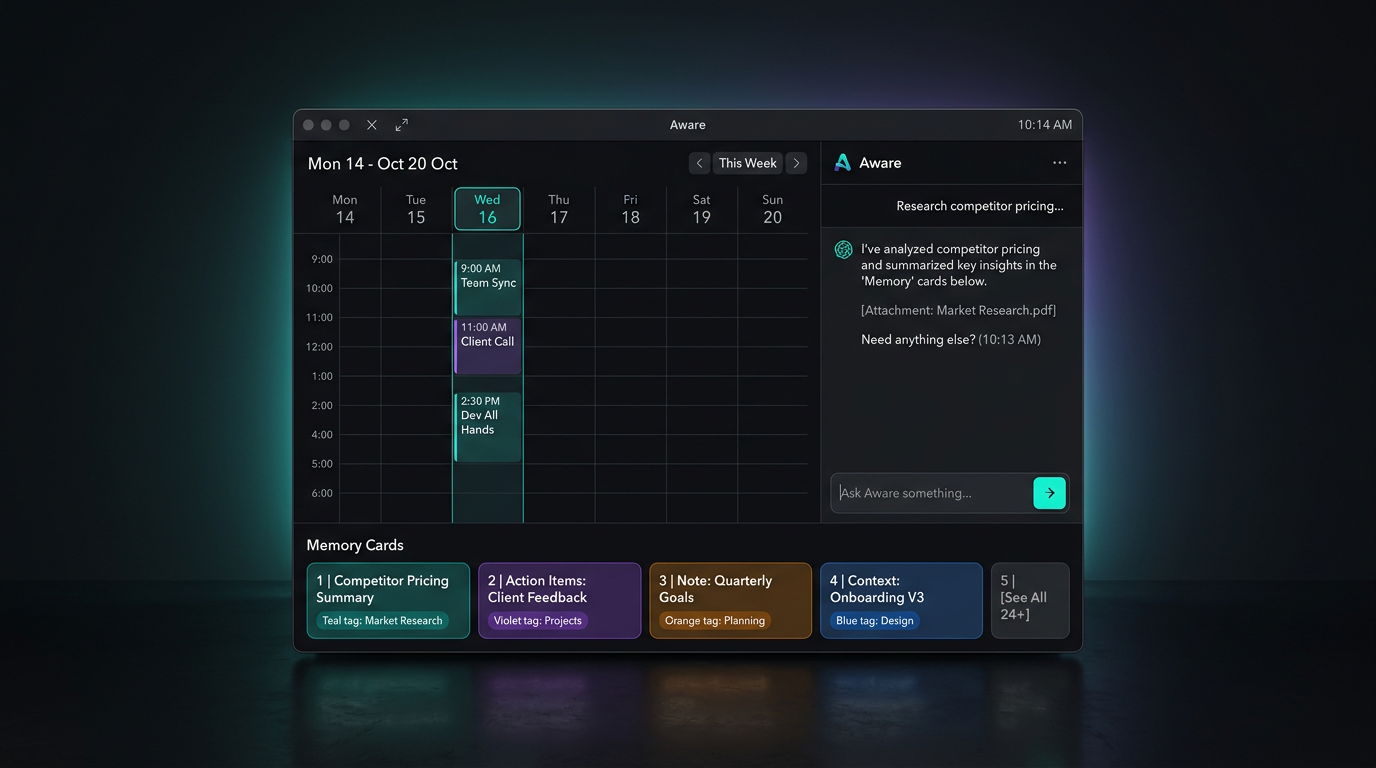
SAN FRANCISCO — Aware, an ambient AI operating layer designed for knowledge workers, announced its official public availability today. The platform moves beyond the conversational chatbot paradigm, operating in the background to connect with a user's existing data streams and provide quiet, contextual assistance throughout the workday.
Unlike task-specific AI tools or command-driven assistants, Aware positions itself as a persistent layer that synthesizes information from a user's professional life. By integrating with core productivity tools, the system aims to build a deep, personal context, surfacing insights and streamlining tasks without requiring constant user prompting. The launch marks a new entry in the growing field of productivity AI, focusing on workflow optimization through ambient intelligence rather than direct interaction.
## Breaking Down the Ambient AI Platform
The core premise of Aware is to act as an intelligent layer that sits atop a user's existing digital environment. Rather than being a destination application that demands active use, it functions more like a background service. It observes, synthesizes, and offers support when it identifies an opportunity, a philosophy the company calls "quiet AI assistance."
This approach is most evident in how the system handles context and memory. Aware employs a "pull-over-push" model for information retrieval. Instead of proactively bombarding the user with every piece of related data it possesses, the system waits for a relevant moment—a question in the chat or an upcoming meeting—to gently surface the specific personal context it has stored. This prevents information overload and ensures that the AI's contributions are additive, not disruptive. All AI-driven answers include an "Aware Insights" chip, which clearly distinguishes between literal evidence pulled from a source document or email and the AI's own inference, providing a necessary layer of transparency.
## Inside the Daily Workflow
For the end-user, the Aware experience is centered on a few key surfaces designed to manage the flow of information and tasks. The platform is not a replacement for an inbox or calendar, but an intelligent aggregator and filter for them.
The entry point for many is the **Daily** surface, a morning briefing that synthesizes a user's calendar, key emails, and other signals into a scannable overview of the day ahead. It prepares the user for what’s important without requiring them to manually trawl through multiple applications first thing in the morning.
From there, a user's interaction is primarily funneled through the **Action Center**. This is a unified notification hub where all of Aware's systems publish items needing attention. It categorizes suggestions as urgent, awaiting-input, or simple for-your-information items. This centralizes the AI’s outputs, preventing pop-ups and other intrusive notifications from breaking a user’s focus. If Aware drafts a reply to an email or suggests preparation materials for a meeting, that prompt appears in the Action Center for user review and approval.
For more direct interaction, Aware offers a **Home Chat** surface. An unobtrusive floating "Core" orb provides a conversational entry point that is always context-aware of the page the user is on within the Aware application, allowing for natural language queries about projects, people, or upcoming events.
## Building a Personal Memory
A central pillar of the Aware platform is its **Memory** capability. This is a long-term knowledge base that the AI builds about the user's professional life, including important facts, people, and projects. This memory is populated in two primary ways: automatically through connected integrations and manually through explicit user instruction.
When a user connects their Google Account, Aware begins to build its understanding by syncing information from services they already use. Key details are imported from:
* **Google Drive:** The system performs a read-only sync of documents to build a contextual understanding of projects and content. It can reference this material to answer questions, but it does not have write permissions.
* **Gmail:** Aware reads the connected inbox to understand communication patterns, key correspondents, and outstanding threads that require a reply.
* **Google Calendar:** Events, attendees, and meeting details are used to understand a user’s schedule and help with preparation or rescheduling.
Beyond this automated ingestion, users can directly "tell" Aware facts to remember. Over time, this creates a robust, personalized knowledge graph that the AI can draw upon to provide highly relevant assistance. For example, a user could ask, "What were the key takeaways from the Q3 planning doc?" and Aware can reference the relevant file in its memory to provide a summary.
## Core Integrations and Connectivity
To enable its ambient capabilities, Aware relies on direct connections to a user's existing toolset. The platform is launching with a focused set of integrations designed to cover the foundational elements of a knowledge worker's day.
The primary integration is with the Google ecosystem. By using Google OAuth, users can grant Aware access to Gmail, Google Calendar, and Google Drive. This single connection is the backbone of the platform's contextual awareness, allowing it to see calendar events, read and draft emails, and scan documents for its long-term memory. The platform emphasizes that Google Drive access is read-only, ensuring that source documents are never altered.
In addition to Google, Aware also offers an integration with Slack. Once connected, Aware can perform "catch-up" scans of a user's Slack account, specifically looking for @mentions and direct messages. This allows it to surface important communications that may have been missed, presenting them within the Aware ecosystem without requiring the user to scroll back through noisy channels.
## Availability
Aware is now available to the public as a web application accessible from any modern browser. Optional mobile shells for iOS and Android are also available, providing a streamlined experience for users on the go. The platform is offered for individual knowledge workers and is also available in multi-seat configurations for small teams.
To get started with the ambient AI platform and explore how it can optimize your daily routines, new users can begin a trial by visiting https://stayaware.ai/trial/handled.