ChatGPT as Your Personal Assistant: A Loving, Critical Review
Everyone has tried it. You open a new chat, give it a few instructions about who you are, and ask it to help you manage your day, your projects, or your inbox…
By Kris Groves
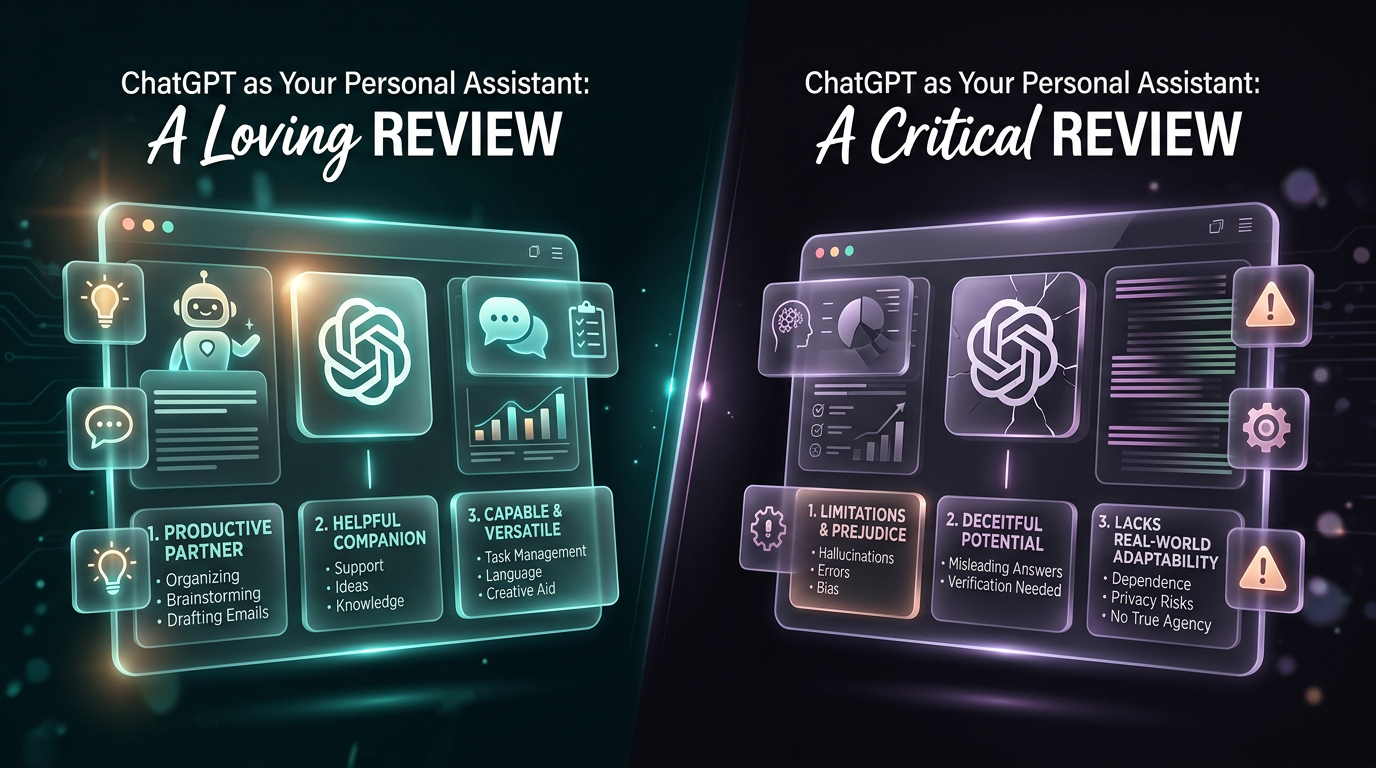
# ChatGPT as Your Personal Assistant: A Loving, Critical Review
Everyone has tried it. You open a new chat, give it a few instructions about who you are, and ask it to help you manage your day, your projects, or your inbox. The idea of using a powerful LLM like ChatGPT as your personal assistant is compelling, but the reality is a story of friction, frustration, and fundamental misunderstanding.
It's a phenomenal tool for generating text. But as an actual assistant, it creates more work than it saves.
## The siren song of a free assistant
The appeal is obvious. Here is a tool, available to anyone with a browser, that can draft emails, summarize articles, and brainstorm ideas with startling fluency. For a moment, it feels like you've unlocked a secret productivity cheat code. The promise is an infinitely patient, impossibly fast helper that costs you nothing.
This initial "wow" factor masks a deeper truth about the nature of work. The hardest parts of a busy professional's life aren't just about writing text. They are about managing context, tracking moving pieces, and making sure nothing gets dropped. This is where the chatbot model begins to fall apart.
## Where the illusion breaks down
The gap between a language model and a true assistant becomes a chasm after about ten minutes of serious use. The core problem is that ChatGPT is a stateless, prompt-driven tool. It’s an oracle, not a partner.
### You are the project manager
Every interaction is a self-contained loop. You provide a prompt, it provides a response. That’s it. It cannot track the status of a project, remind you to follow up, or manage a sequence of tasks over time.
You become the human middleware, constantly copying information from one window, pasting it into the chat, then copying the output to a third location. This isn't assistance; it’s manual data entry with a clever thesaurus. The cognitive load of managing the assistant becomes greater than the load of doing the work yourself.
### A memory made of sand
ChatGPT has no persistent memory of you, your priorities, your colleagues, or your projects outside of the current conversation thread. Every time you start a new task, you are effectively re-introducing yourself to an assistant with profound amnesia.
You have to feed it the same background context again and again. It doesn’t know that "Project Atlas" is your top priority this quarter or that when you say "email Sarah," you mean Sarah from marketing, not your cousin Sarah. This lack of continuity forces you to do the heavy lifting of maintaining context.
### It has no agency
A real assistant *does* things. They schedule meetings, send emails, update project boards, and file documents. ChatGPT can only *write about* doing those things. It can draft a perfect email, but it cannot press send. It can outline a project plan, but it can’t create the tasks in your project management tool.
It lives exclusively within a browser tab, completely disconnected from the software where your work actually happens. This makes it a simulator, not an executor.
## The anatomy of real assistance
So, is a true AI personal assistant just a fantasy? No. But it requires a fundamentally different architecture than a chatbot. Real assistance is about reducing cognitive load, not just generating words.
A genuinely useful assistant must have:
* **Persistence:** It needs to remember you, your work, and your preferences over time.
* **Context:** It must understand your projects, priorities, and the people you work with.
* **Agency:** It needs permission and integrations to perform actions in your other tools.
* **Proactivity:** It should anticipate needs, not just react to prompts. It should see an email about scheduling and suggest times, without you even asking.
It’s the difference between having a conversation about your to-do list and having an assistant that actually helps you complete it.
> Using a chatbot as an assistant is like hiring a brilliant intern with total amnesia every five minutes.
The work required to constantly bring them up to speed negates the value of their brilliance.
## Leveraging ChatGPT for what it’s good for
This isn't to say that ChatGPT is useless for productivity. Quite the opposite. When used as the specialized tool it is—a world-class text and idea generator—it's incredible. You just need to know when to use it and, more importantly, when not to.
The best use cases for ChatGPT involve self-contained generation tasks.
1. **Brainstorming:** Use it as a sparring partner to generate a high volume of ideas quickly. *"Give me 20 potential names for a new marketing podcast."*
2. **First Drafts:** Overcome the blank page by having it produce a rough draft of an article, memo, or presentation script. *"Write a 500-word blog post about the benefits of asynchronous communication."*
3. **Reframing & Rewriting:** Paste in your own clunky writing and ask it to improve clarity, change the tone, or shorten it. *"Make this sound more confident and cut it by 30%."*
4. **Summarization:** Feed it a long article or transcript and ask for the key takeaways. This is far better than asking it to summarize something from a URL, which can lead to hallucinated content.
For these tasks, it's an exceptional tool. But notice that none of them require persistent context or agency. They are one-shot operations.
## The problem with a ChatGPT personal assistant
The core issue of the **ChatGPT personal assistant** concept is friction. By forcing you to live in a chat window, it adds another screen to your workflow. You are constantly toggling between your email, your calendar, your documents, and the chat, acting as the bridge between them all.
An effective system should be ambient. It should work *for* you in the background, integrated into the tools you already use, with a persistent understanding of your work. It should not require you to stop what you're doing to go explain your world to a chatbot. **A true assistant makes your life simpler**, reducing the number of steps and decisions required to get something done. A chatbot, when used for this purpose, often does the opposite.
## From prompts to partnership
The future of productivity isn't about becoming a better prompt engineer. It’s about having an intelligence layer that understands the context of your work and can execute tasks on your behalf.
This means moving beyond the prompt-and-response loop. It requires an AI that has a memory, that is integrated with your tools, and that can act with a degree of autonomy to truly take work off your plate. You don't want a chatbot. You want things handled.
If you’re tired of being the human API for a chatbot, it might be time to experience what a truly integrated AI partner feels like. Try Aware free — see what 'handled' actually feels like by visiting us at https://stayaware.ai/trial/handled.