Cross-System Context: The Missing AI Feature You Didn't Know You Wanted
Your AI assistant is a brilliant amnesiac. It can write a sonnet or a line of code, but it has no idea what you were just doing in Slack five seconds ago…
By The Aware Engineering Team
# Cross-System Context: The Missing AI Feature You Didn't Know You Wanted
Your AI assistant is a brilliant amnesiac. It can write a sonnet or a line of code, but it has no idea what you were just doing in Slack five seconds ago. This digital short-term memory loss is the single biggest bottleneck in AI today, forcing you to constantly copy, paste, and explain yourself. True productivity requires `cross system context ai`—an intelligence that understands your work as you do it, across all your applications.
## The illusion of smarts
The current generation of AI tools ares impressive conversationalists. They operate within a chat window, a text box, or a single application's silo. You give them a prompt, they give you a response. It feels intelligent, but it's a narrow, theatrical form of smarts.
This model lacks genuine `ai context awareness`. The AI has no memory of the tab you just switched from, the notification you just dismissed, or the document you have open on the other side of your screen. It’s like having an assistant who can only see a single piece of paper at a time and forgets everything a moment after you hand them the next one. This isn't a partnership; it's a series of disconnected transactions.
## Your workflow is a silo farm
Think about your last hour of work. You likely bounced between a dozen different tabs and applications. Each one is a digital silo, holding a piece of the puzzle that makes up a project or a task.
The average workflow is a constant shuffle between these information islands. A typical project might involve:
* Client conversations happening in Slack or email.
* The project plan living in Notion or Asana.
* Specific tasks and bug reports tracked in Linear or Jira.
* Design files stored in Figma.
* The actual work happening in a code editor or Google Doc.
No single tool has the full picture. And because your AI only lives in one of these places at a time (or in its own separate window), it can't possibly grasp the complete context of your work. It's blind to the connections you make effortlessly in your own mind.
## What is cross system context AI?
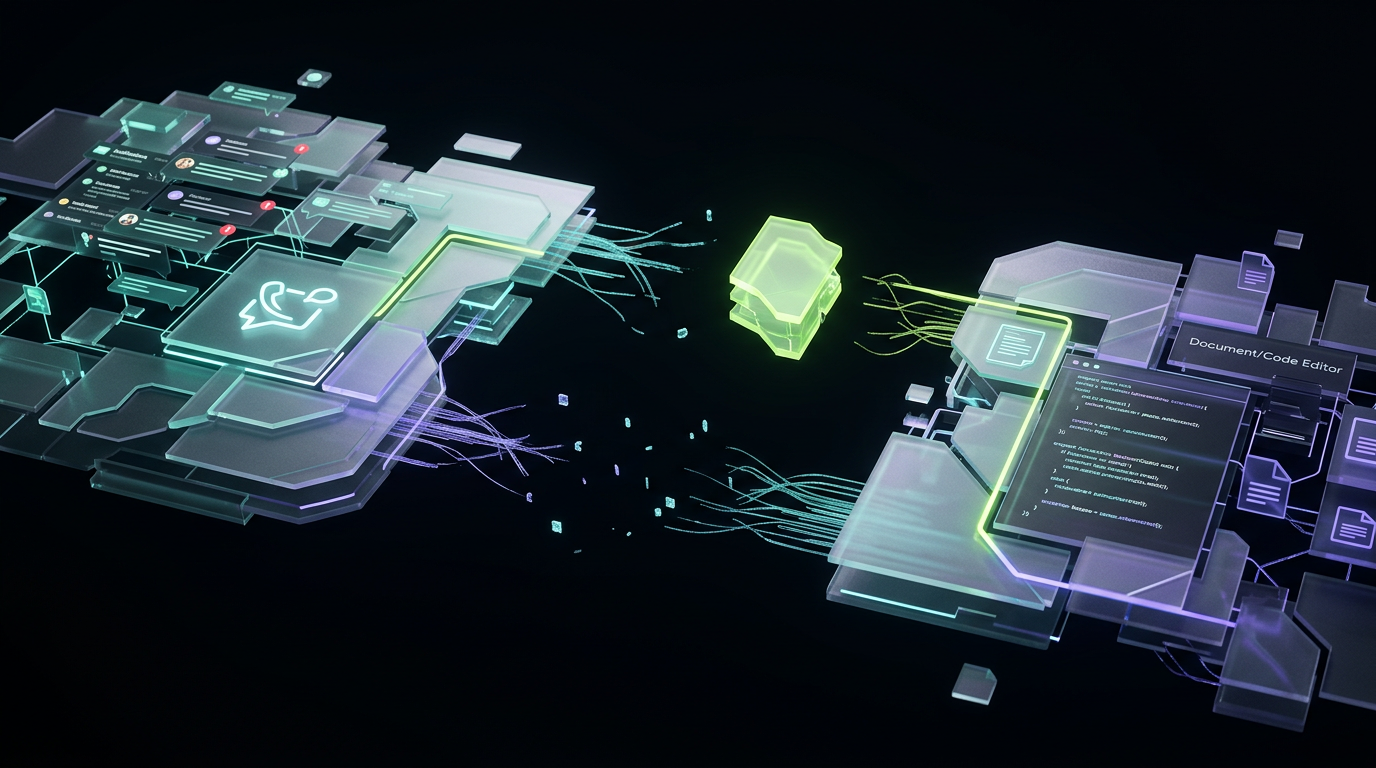
Cross-system context is the ability for an AI to perceive and understand information across multiple, disparate applications in real-time. It’s not about integrating two apps via a clunky API; it’s about creating a unified AI context layer that sits above your entire digital workspace.
This is the difference between an AI tool and an AI partner. A tool waits for you to bring it information. A partner sees the information alongside you.
> Most AI tools are a solution looking for a problem. True context-aware AI is the opposite; it's a solution to a problem so fundamental you stopped noticing it was there.
Imagine an assistant who can glance at your screen. They see the email from Sarah, the project plan in Notion it relates to, and the open calendar invite for the follow-up call. When you ask them to "draft a reply to Sarah summarizing the next steps," they don’t need you to paste seventeen different links. They just *know*. That is the promise of an AI that works across apps.
## Fixing the broken loop
Today’s AI workflow is a manual, repetitive loop that negates much of the time saved. It’s a frustrating dance of command-tabbing and copy-pasting.
The current process looks something like this:
1. **Identify a need:** You need to summarize a long thread in Slack for a client email.
2. **Gather context manually:** You highlight and copy the relevant Slack messages. Maybe you also grab a link to a related document from another tab.
3. **Switch to the AI:** You open a new tab for your chatbot of choice.
4. **Prime the AI:** You paste the copied text and write a detailed prompt explaining what you need, who the audience is, and what the goal is.
5. **Generate and review:** The AI gives you a response. You proofread it.
6. **Switch to the destination:** You copy the AI's output and tab over to your email client.
7. **Paste and format:** You paste the text and clean it up.
This isn't seamless. It’s a seven-step context-gathering tax you pay every time you want to use AI for a non-trivial task. **True AI assistance should reduce steps, not add new ones.** Imagine seeing your core context—people, projects, documents—pulled automatically into a simple command bar. The AI knows what ‘the project design’ refers to because it sees the Figma link you just clicked.
## The benefits are grounded, not aspirational
When an AI understands the context of your work across applications, the benefits aren't futuristic fantasies. They are immediate, practical improvements to your daily workflow. This isn't about robot butlers; it's about eliminating the thousand tiny points of friction that drain your focus and energy.
### Speed through understanding
By automatically perceiving the relevant documents, conversations, and people related to your current task, the AI can anticipate your needs. Drafting an email, summarizing a meeting, or finding a file becomes an instant action, not a research project.
### Accuracy through visibility
Context is everything. An AI that can see the client’s message in your inbox *and* their support ticket history in your CRM will generate a far more accurate and empathetic response than one that only sees the text you pasted. It stops hallucinating details because it has the real details right in front of it.
### Reduced cognitive load
The most underrated benefit is a quieter mind. You offload the mental burden of tracking connections between apps. You no longer need to hold a dozen threads in your head just to write a simple update. This frees up your focus for the work that actually requires your intellect. Building a `unified ai context` lets the machine handle the metadata of your work, so you can handle the substance.
The future of productive work isn't another app you have to manage. It's an intelligent layer that makes all your existing apps work better, together. An AI that works `across apps` transforms them from a collection of isolated tools into a single, cohesive workspace.
The problem has been clear for years, but the solution was technically difficult. It required moving beyond the simple chat-in-a-box model and building something fundamentally new: an ambient intelligence that operates at the OS level. It’s a harder path, which is why so few have taken it.
The premise of our work at Aware is that `cross system context ai` is not a "nice-to-have" feature. It is the core requirement for AI to become a truly transformative part of your professional life. We built the platform that this post describes. It’s not an idea; it’s a shipped product you can use right now.
To see what it feels like when your AI finally has a memory, get access to Aware. Your trial is completely free.