Focus Protection: The AI Feature Nobody Asks For, Until They Try It
Nobody puts “focus protection” on their feature request list
By The Aware AI Team
# Focus Protection: The AI Feature Nobody Asks For, Until They Try It
Nobody puts “focus protection” on their feature request list.
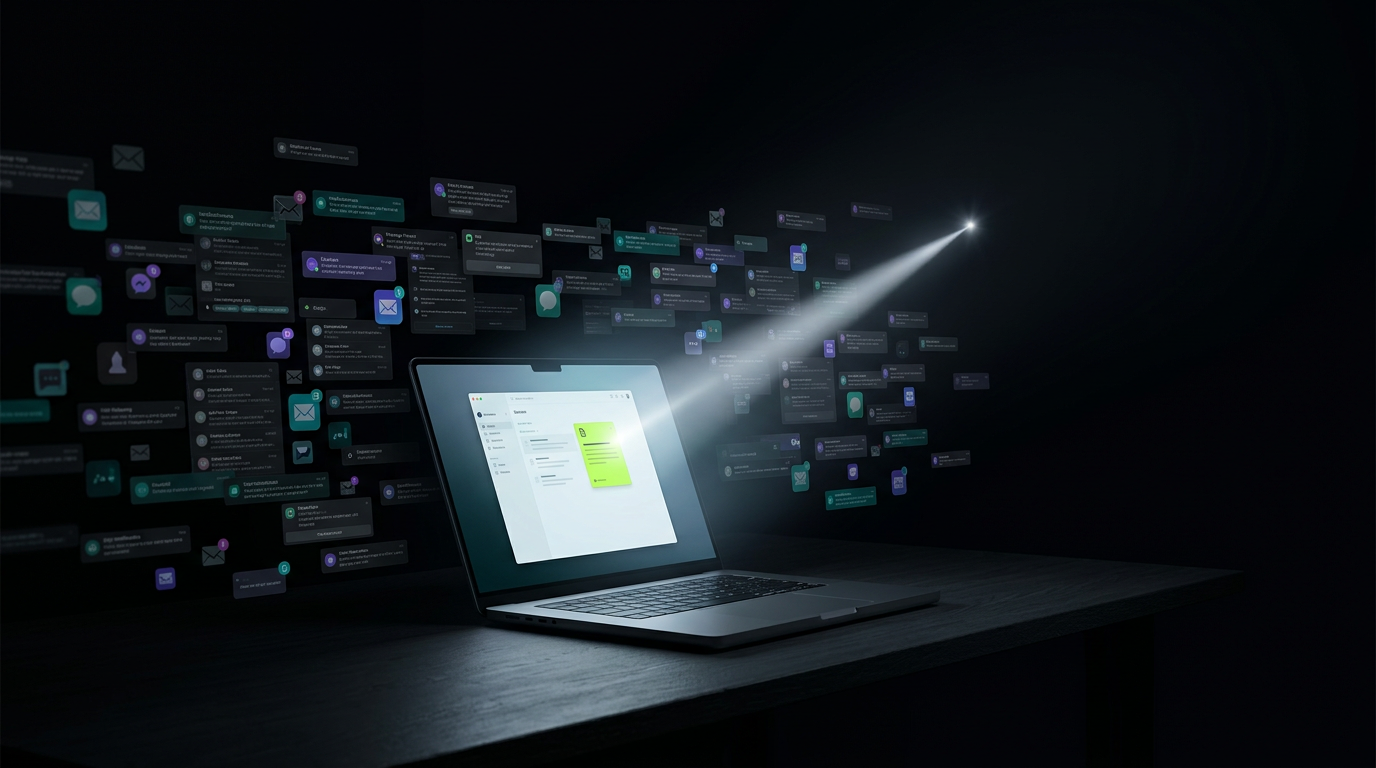
They ask for “smarter notifications” or “a better do-not-disturb.” But what they’re really describing, what they truly need, is a system that actively defends their attention without making them paranoid. That system is **ai focus protection**.
## The problem with 'focus modes'
Your phone and operating system already have a “Focus Mode.” You’ve probably tried it. You’ve also probably turned it off and forgotten about it.
These tools are a blunt instrument. They are binary switches that put all the work on you. You have to remember to turn them on. You have to remember to turn them off. You have to spend an eternity in settings, trying to whitelist specific apps or contacts, creating a fragile system that breaks the moment your workflow changes.
The result is a constant, low-grade anxiety. You turn on Focus Mode to write a proposal, but you can’t fully concentrate because you’re worried about missing an urgent email from the client the proposal is for. The tool designed to help you focus is actively undermining your peace of mind. It’s a classic case of the cure being part of the disease.
## Attention is not a toggle switch
Deep work isn’t a state you achieve by flipping a switch. It’s a fragile state you enter and must carefully maintain. Research shows that a single, irrelevant notification—even one you consciously ignore—can shatter your concentration and cost you over 20 minutes of productive time to recover.
The goal isn't just to block interruptions. It’s to create an environment where your mind feels safe enough to stop scanning for threats and fully commit to the task at hand. This feeling of safety is impossible when you’re relying on a dumb toggle. You know it's an all-or-nothing proposition, so your brain keeps a portion of its resources on high alert.
> Your brain can't commit to deep work if it suspects it's missing something important. Traditional focus modes create this exact suspicion.
An effective `ai focus mode` understands this. It’s not about building a higher wall; it’s about installing a doorman with perfect judgment. It knows who to let in and who to ask to wait. This subtle shift from blocking to triaging is what separates a gimmick from a genuine cognitive enhancement.
## How ai focus protection actually works
True `ai focus protection` doesn’t see the world in black and white. It operates in shades of gray, constantly assessing a stream of information to decide what warrants your attention *right now*. It moves beyond simple rules to a deep, contextual understanding of your work.
With *Aware*, this isn't a feature you configure. It's the default state. It learns from every interaction, becoming a silent partner that understands the rhythm and priorities of your day.
### Understanding context and intent
An effective focus assistant AI doesn’t just read keywords; it understands intent. It learns the difference between a client’s casual question and a system-down emergency. It knows which projects are on fire and which are simmering on the back burner.
This intelligence comes from observing your behavior. What do you respond to immediately? What gets snoozed? Which conversations involve key stakeholders? Over time, *Aware* builds a sophisticated model of your professional life, allowing it to triage incoming information with an accuracy that simple keyword filters can’t touch.
### Dynamic and adaptive shielding
Your need for focus isn’t static, so your protection shouldn't be either. The shield metaphor is apt. Sometimes you need a heavy tower shield; other times, a light buckler is enough.
*Aware*'s AI dynamically adjusts the strength of its filter based on your current context. If you have a “Deep Work” block scheduled in your calendar, the shield becomes nearly impermeable, letting only the most critical alerts through. If you’re in a meeting, it understands that notifications related to that meeting’s topic are likely relevant. When you’re just clearing your inbox, the shield is at its most permissive. It is an ambient system, adapting without your input.
## What gets through the shield?
This is the critical question, and the one that determines whether you can truly trust the system. The fear of missing something genuinely important is what makes most people abandon focus tools. An intelligent system must be transparent and reliable in what it allows through.
*Aware* uses a weighted model of several signals to make this judgment call. It’s not one thing; it’s the combination of everything.
1. **Sender Priority:** The system quickly learns your personal and organizational hierarchy. Communications from your direct manager, a key client, or a C-level executive are weighted more heavily than an email from an unknown vendor.
2. **Semantic Urgency:** The AI analyzes the actual language and sentiment of the message. Phrases like “server is down,” “completely blocked,” or “need this ASAP” are powerful indicators, especially when combined with other signals. It distinguishes between real urgency and the fake urgency of a marketing email.
3. **Your Current State:** Your context is paramount. An email about “Project Falcon”—a project you haven’t touched in six months—is less likely to be immediately important than a Slack message about “Project Eagle,” which your calendar shows you’re actively working on.
4. **Behavioral History:** The system learns from you. If you consistently and immediately open messages from a specific person or about a specific topic, *Aware* learns that this is a priority for you and will be less likely to hold it back in the future.
5. **Chain of Events:** A single message might not be urgent, but the third rapid-fire follow-up from the same person probably is. The AI tracks conversation velocity to detect escalations.
By synthesizing these signals, the system makes an intelligent choice, freeing you from the cognitive labor of making thousands of these tiny decisions yourself every day.
## The silent partner for deep work ai
The best sign that an `ai focus protection` system is working is that you forget it’s there. You don’t notice the alerts it blocked. You just notice that you’re finishing tasks without being derailed. You feel less scattered and more in control.
This is the essence of an ambient AI. It shouldn’t be another app to manage or another dashboard to check. It should fade into the background, doing its job silently and effectively. Its presence is felt not as an interruption, but as an absence of interruptions.
The quiet that *Aware* provides isn’t just about getting more done. It’s about preserving your most valuable resource: your cognitive energy. The constant tax of context switching is exhausting. By offloading that burden, you gain significant benefits.
* Longer, uninterrupted blocks of true concentration.
* Reduced mental anxiety about what you might be missing.
* More creative and strategic energy at the end of the day.
* A concise, intelligent summary of what was held for you, ready when you are.
You don’t need more notifications. You need fewer, better ones. You need a system that respects your attention as a finite resource and helps you deploy it where it matters most.
You don't ask for `ai focus protection` by name because you're used to clumsy tools that demand your constant attention. It’s time to expect more. A system shouldn’t just block noise; it should deliver signal. It should work for you, not the other way around.
Stop reading about it. [Try Aware free](https://stayaware.ai/trial/handled).