Lindy vs Aware: Agents That Run Tasks vs. Aware That Runs Your Day
The promise of a personal AI assistant is finally getting real, but the approach matters more than the hype
By Kris Groves
# Lindy vs Aware: Agents That Run Tasks vs. Aware That Runs Your Day
The promise of a personal AI assistant is finally getting real, but the approach matters more than the hype.
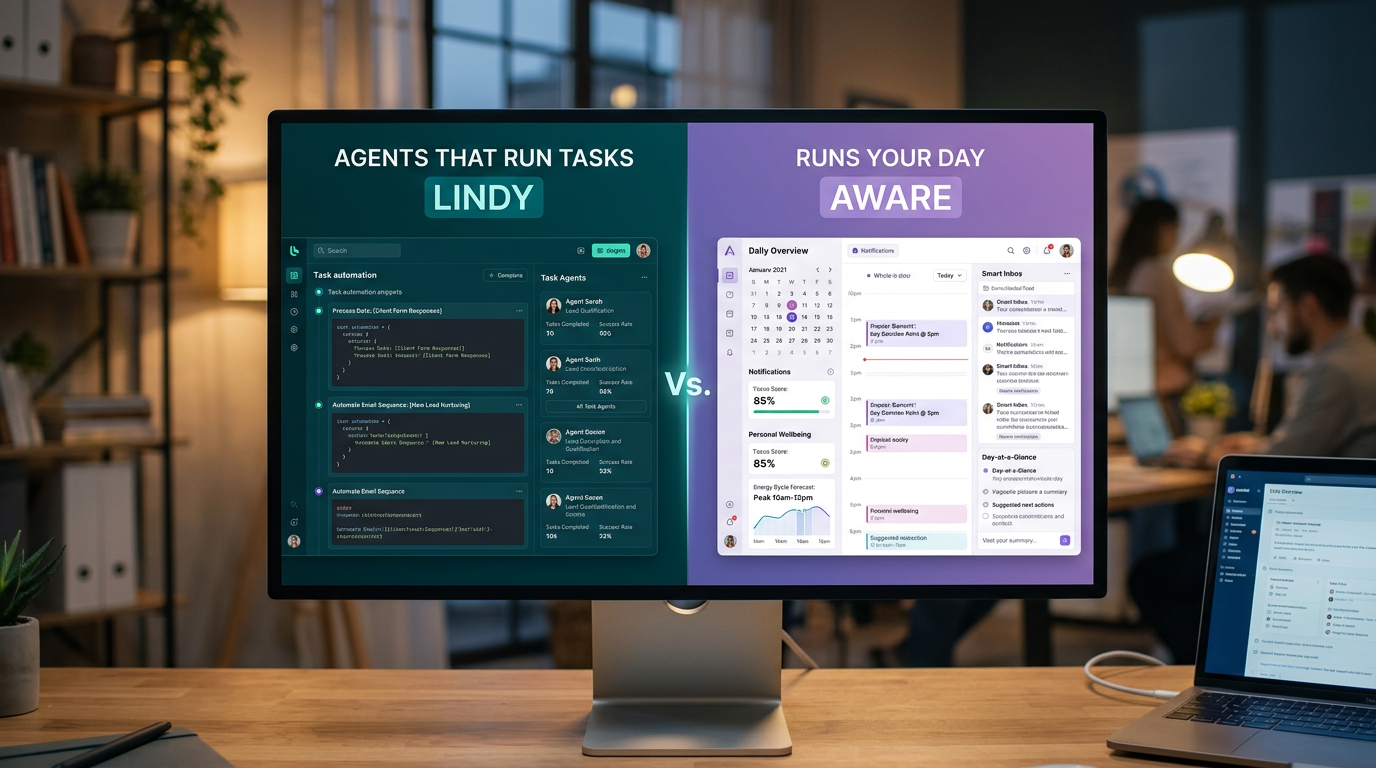
You can either hire a swarm of hyper-specific digital interns to run errands, or you can install an operating layer that understands the context of your entire day. This is the core of the *Lindy vs Aware* debate: a collection of single-purpose agents versus one unified system of intelligence. One requires constant management; the other simply works.
## The agent-based promise
The idea behind tools like *Lindy* is appealingly direct. You build or use pre-made "agents" to handle discrete, repeatable tasks. Need to summarize meeting notes? There's an agent for that. Want to triage support emails by keyword? Spin up another agent.
These personal AI agents are designed to be specialists. You point them at a specific data source, give them a clear instruction set, and they execute. This works well for isolated, predictable chores. It’s automation, but with a conversational interface. You delegate, and the bot does the thing. On paper, it’s a productivity force multiplier.
But the paper often leaves out the fine print.
## The problem with tasks
The agent-based model creates a new job for you: Chief Robotics Officer. Your day becomes about managing your fleet of bots, ensuring they have the right inputs, and manually connecting their outputs.
### The burden of orchestration
Each agent is a silo. The agent that transcribes your sales call has no idea what the agent that schedules your follow-ups is doing. The agent sorting your email doesn't know which messages relate to the project your other agent is tracking in Notion.
You become the human middleware, the connective tissue that has to tell Agent A to send its output to Agent B. This isn't freedom from work; it's a new, more complex kind of work. It’s digital delegation, but the buck still stops with you to make sure everything connects.
### Context is king, and agents are paupers
An agent only knows what you explicitly give it. It lacks the ambient, peripheral awareness that is the hallmark of true assistance. It can execute a command, but it can’t anticipate a need because it doesn’t understand your world.
It doesn’t know you just had a tense Slack thread with a colleague before jumping on a client call. It doesn’t know the document you referenced in passing is the same one a client emailed you about last week. This lack of holistic context means its usefulness is permanently capped. It can only ever be as good as the last command you gave it.
## Aware runs your day, not just your errands
Aware doesn’t give you a toolbox of bots to manage. It's a single, persistent layer of intelligence that integrates with the tools you already use—your calendar, email, and messaging apps.
It doesn't wait for you to delegate tasks. Instead, it passively observes the natural flow of your work to understand what's important, who you're talking to, and what needs to happen next. It connects the dots for you, automatically. This isn’t about task automation; it's about cognitive offloading.
**Aware is a system of intelligence, not a collection of tools.** It’s built on the premise that your most valuable work isn’t executing tasks, but thinking, connecting, and deciding. We handle the rest.
## So what does that actually mean?
Instead of you feeding information to a bot, Aware ingests your workstreams automatically. It sees your upcoming meeting in Google Calendar, finds the related email thread in Gmail, and pulls up the relevant notes from your last conversation—all without you lifting a finger.
It prepares you for your day and cleans up after it. Before a meeting, you get a brief on who you’re meeting and what you last talked about. After the meeting, a draft follow-up is already waiting for you, complete with a summary and identified action items.
> An army of single-purpose bots doesn’t create intelligence. It creates a management problem with a futuristic coat of paint.
True assistance comes from a system that understands the relationship between events, conversations, and people over time. It’s the difference between a calculator and an accountant. One does sums, the other provides financial strategy.
## The Lindy vs Aware distinction in practice
Let’s use a simple scenario: you’ve just finished a 45-minute discovery call with a new lead, "Jane from Acme Corp."
With an agent-based tool like *Lindy*, your workflow might look like this:
* Trigger an agent to transcribe the audio from the call.
* Copy that transcript.
* Feed the transcript to a second agent and ask it to "write a follow-up email."
* Review and edit the email, because the agent has no context on your prior relationship with Acme Corp.
* Manually create a new task in your project manager to "Follow up with Jane in 7 days."
* Find the deck you mentioned on the call and attach it to the email before sending.
You’re still the project manager, directing a series of disconnected tools.
Now, here’s how it works with Aware:
1. Aware was in the meeting with you, so it’s already transcribed the conversation in real-time.
2. Because it’s also connected to your email, it knows you’ve exchanged three emails with Jane before. It also sees the "Acme Corp Q3 Proposal" document you worked on last week.
3. Minutes after the call ends, a notification pops up. Aware has pre-drafted a follow-up email that not only summarizes the call and action items but also references a key point from your previous email chain. It even suggests attaching the Q3 proposal.
4. The action items are already formatted as tasks, ready to be sent to your project management tool with a click.
One system required you to act as a switchboard operator. The other simply understood what needed to happen and did it.
## Finding the right Lindy alternatives
The search for *Lindy* alternatives often leads to more of the same: slightly different platforms for building and managing single-purpose agents. This is a lateral move, not a step up. It mistakes a more efficient task-doer for a better way to work.
The real alternative isn't a better agent-builder. It’s a shift in philosophy.
It’s moving away from a model where you have to constantly identify, define, and delegate tasks. The most powerful solutions, like Aware, are ambient. They reduce your cognitive load not by checking off more items on your to-do list, but by removing the need for you to create that list in the first place.
The ultimate productivity tool isn't one that requires you to become a better manager of bots. It's one that lets you forget about the mundane logistics of your work entirely, confident that they are being handled in the background. The *Lindy vs Aware* question is really about whether you want more tools to manage or more time to think.
---
Try Aware free — see what 'handled' actually feels like.