Meeting Notes Are Half the Job. Here's the Other Half.
Your meetings are full of great ideas, clear decisions, and firm commitments
By The Aware AI Team
# Meeting Notes Are Half the Job. Here's the Other Half.
Your meetings are full of great ideas, clear decisions, and firm commitments.
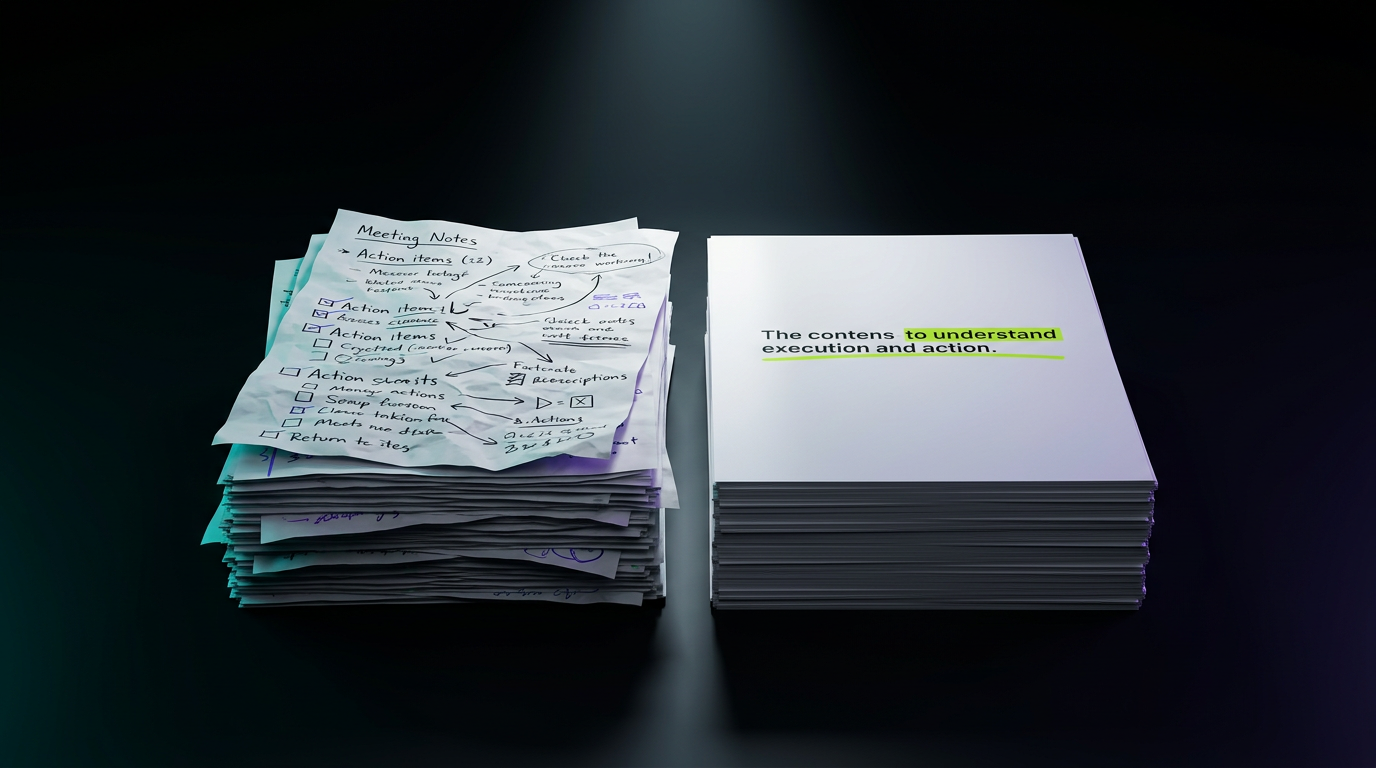
But the notes you take are where they go to die. Even with a perfect transcript, the document itself is static—a fossil of a conversation. The real work isn't capturing what was said; it's making sure what was promised actually happens. That requires a deliberate, structured **ai meeting follow up** process, and most teams simply don’t have one.
## Notes are a record, not a result
Let’s be honest about what meeting notes are. They are artifacts. A good set of notes tells you who was there, what was discussed, and what decisions were made. A great set of *AI meeting notes* might even provide a flawless transcript, a neat summary, and a list of keywords.
This is all useful information. It is not, however, an outcome.
The world is littered with beautifully formatted Google Docs, Notion pages, and Confluence wikis that nobody has looked at since the day they were created. They represent potential energy. Without a system to convert that potential into the kinetic energy of action, the notes are just a memorial to an hour of your team’s life. The meeting might as well not have happened.
## The friction of manual follow-up
The gap between the meeting and the action is where everything falls apart. The manual process for bridging this gap is so tedious that most people, even with the best intentions, give up.
It looks something like this:
1. Spend 15 minutes after the meeting trying to clean up your messy, half-coherent notes.
2. Attempt to decipher who actually committed to doing what. Was that a firm deadline or a vague suggestion? Who owns this, really?
3. Manually copy and paste these "action items" into a new email or Slack message.
4. Craft a polite, professional summary to give context to the list of tasks.
5. Triple-check the email to make sure you haven't mis-assigned a task or misinterpreted a decision, creating a new problem.
6. Hit send and hope people read it.
7. Spend the next two weeks chasing down individual owners, asking for status updates in a way that doesn't feel like nagging.
This isn’t strategy. This is administration. It’s draining, error-prone work, and it’s the primary reason that momentum from a great meeting evaporates by the next morning.
## AI notes are table stakes now
Plenty of tools have figured out how to record and transcribe your meetings. Getting a summary and a list of highlights is no longer a novelty. It's the baseline.
But these tools have only solved the first, easier half of the problem. They’ve perfected the art of creating the artifact. They give you a better, faster, more accurate record of the conversation. What they don't do is ensure the conversation leads to anything tangible. They deliver a better rearview mirror, not a steering wheel.
> A perfect summary of a meeting that leads to no action is just a well-written obituary for an hour of your life.
This focus on the "record" has created a false sense of productivity. We feel accomplished because we have a neat summary, but nothing in the business has changed. True productivity doesn't come from documenting the past; it comes from shaping the future.
## The anatomy of a proper AI meeting follow up
A system designed for outcomes treats the meeting transcript as raw material, not the final product. An effective **ai meeting follow up** workflow doesn’t just summarize—it activates. It understands that the purpose of the meeting is the work that happens *after* the meeting.
### It extracts commitments, not just tasks
There's a critical difference between a task and a commitment. A task is "Send the report." A commitment is "David will send the finalized Q3 marketing report to the client by Friday at 5 PM." It has an owner, a specific deliverable, and a deadline.
A passive note-taker might identify the phrase "send the report" as a possible action item. An active system like *Aware* understands conversational context, identifying the owner and the timeline to create a concrete, accountable commitment. **This is the core of accountability.**
### It drafts the communication for you
The biggest hurdle to effective follow-up is the activation energy required to write the summary email or Slack post. A truly helpful system removes this friction entirely. Instead of giving you a list of things you need to tell other people, it prepares the message for you.
This is what a real *meeting action items AI* should do:
1. Parse the conversation for key decisions and commitments.
2. Draft a concise, neutral summary of what was decided.
3. List each commitment with its clear owner and deadline.
4. Package it all into a ready-to-send draft in your email or messaging app.
Your job is reduced from "author" to "editor." You simply review the drafted follow-up, make any necessary tweaks, and press send. The entire process takes seconds, not half an hour.
### It integrates with your work, not your notes app
That follow-up email is still just a message. For work to get done, those commitments need to land in the systems where your team already operates. An action item that lives and dies in an email thread is a forgotten action item.
The final step of an intelligent follow-up is routing work to the right place.
* A new feature request from a customer call should become a ticket in Jira.
* A promise to send a proposal should create a task in your CRM.
* A blog topic idea should land on the marketing team’s Trello board.
The goal isn't to create a new "meeting dashboard" that becomes yet another inbox to manage. The goal is to use the meeting's output to fuel the existing workflows that run your business. The meeting becomes a trigger, not a destination.
## From passive recorder to active agent
For the past few years, AI for meetings has been stuck in passive mode. It listens, it transcribes, it summarizes. It’s a very good stenographer. But you don't need a stenographer; you need an operator. You need a system that helps you *do* things, not just remember what you said you were going to do.
This is the shift that matters. It’s the difference between an AI that catalogs your conversations and an AI that helps you execute on them. The job isn't to have better notes—it's to have better outcomes. The real job is the **ai meeting follow up**, and now it can finally be automated.
Stop reading about it. Try Aware free.