Model Routing: Why Your AI Should Pick the Model, Not You
Picking the right AI model for a task feels like a test you didn't study for. One look at the typical AI chat interface confirms it: a dropdown menu asking you to…
By The Aware Engineering Team
# Model Routing: Why Your AI Should Pick the Model, Not You
Picking the right AI model for a task feels like a test you didn't study for. One look at the typical AI chat interface confirms it: a dropdown menu asking you to choose between GPT-4 Turbo, Claude 3 Sonnet, Llama 3, Gemini Pro, and an ever-growing list of inscrutable names. This isn't user empowerment; it's a design failure that offloads a complex engineering decision onto the user. True intelligence in a system isn't just about its outputs—it's about how it handles the inputs, and that includes the tool selection process itself.
## The wrong choice to make
Forcing an end-user to perform manual `ai model selection` is a sign of an immature product. It’s a temporary stopgap that mistakes exposing the plumbing for providing a feature. Your job is to draft a sales follow-up, not to become a part-time AI supply chain manager weighing the token costs and reasoning capabilities of a dozen different models.
This constant decision-making creates cognitive friction. Every time you have to pause and wonder, "Is this task complex enough for Opus, or can I get away with Haiku?" you are pulled out of your actual work. It’s a distraction masquerading as control. The best tools don't ask you how they should work; they just work.
You don't select the specific sorting algorithm for your spreadsheet when you click "Sort A-Z." You don't choose the compression codec when you export a PDF. Sophisticated software handles these background optimizations for you. AI should be no different.
## Not all models are created equal
The reason that dropdown menu exists is because different Large Language Models (LLMs) have different strengths, weaknesses, and costs. The industry has settled on a spectrum of models because no single one is the best at everything. Understanding this landscape is key to understanding why manual selection is so inefficient.
### The Powerhouses
These are the large, cutting-edge models like GPT-4 and Claude 3 Opus. They excel at tasks requiring deep reasoning, complex instruction-following, creative generation, and nuanced analysis. They can write code, dissect dense legal documents, and generate multipage strategic plans. The trade-off? They are the slowest and most expensive to run. Using them for simple tasks is like hiring a master architect to design a doghouse.
### The Workhorses
Models like Claude 3 Sonnet or Gemini Pro sit in the middle. They offer a strong balance of capability and efficiency. They are great for the bulk of professional work: drafting well-structured emails, summarizing long articles, and answering questions with reliable accuracy. They are significantly cheaper and faster than the top-tier models, making them the default for many well-designed systems.
### The Sprinters
This category includes smaller, highly optimized models like Claude 3 Haiku or Llama 3 8B. Their primary advantage is **speed** and extremely low cost. They are perfect for tasks that need to be near-instantaneous: classifying customer support tickets, extracting keywords from a paragraph, reformatting text, or providing quick answers to simple questions. Their reasoning is less powerful, but for a huge number of tasks, that power is simply not needed.
> Asking a user to pick an AI model is like asking a driver to pick the engine's fuel-air mixture ratio. It’s a category error.
The goal isn't for you to memorize this taxonomy. The goal is for the system you use to know it and act on it for you.
## Enter ai model routing
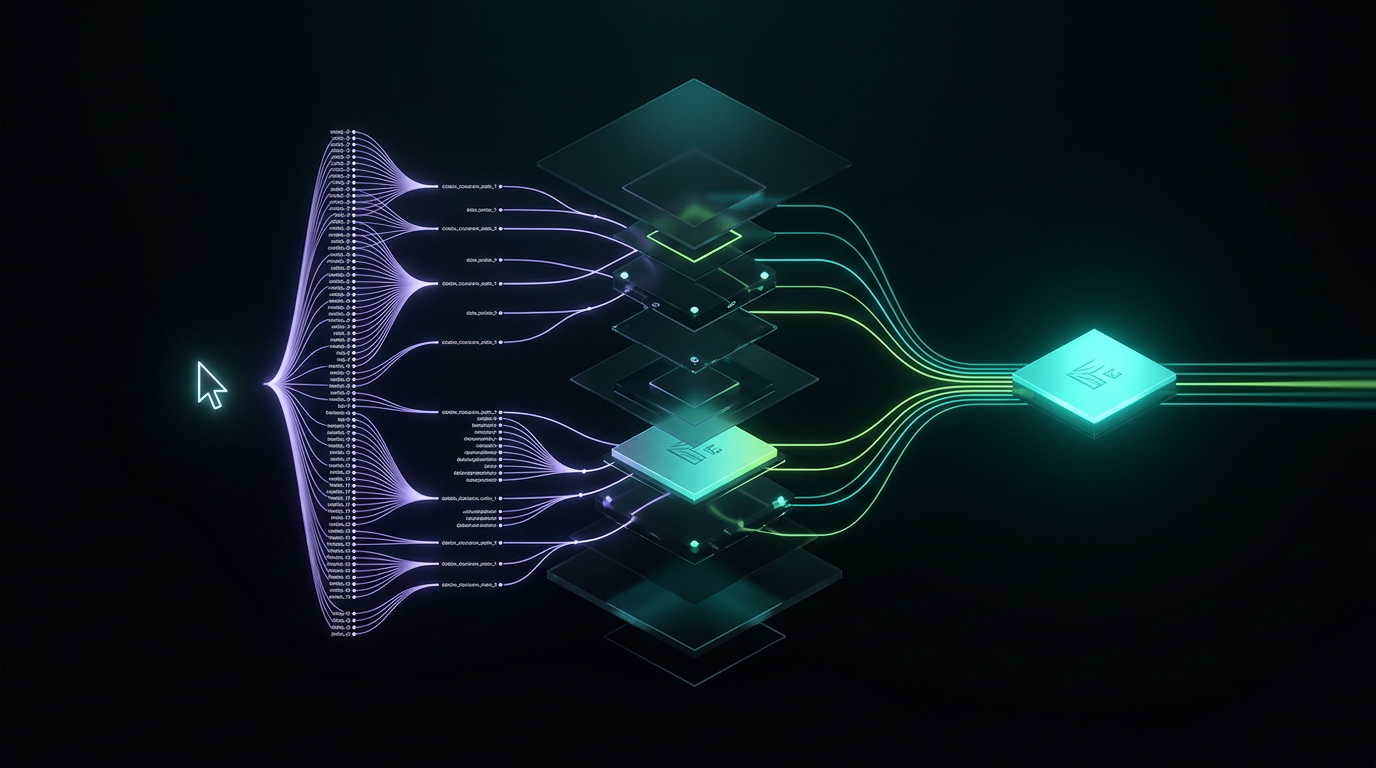
This is where `ai model routing` comes in. It’s an intelligent layer that sits between you and the universe of LLMs. Instead of you picking a model, the router analyzes your request and automatically sends it to the most appropriate model for the job. Think of it as a smart dispatcher for your thoughts.
An effective `llm router` is the core of any serious `multi model ai` strategy. It treats the various LLMs not as a menu of options, but as a portfolio of specialized resources. The router’s job is to deploy the right resource for the right task, in real-time, without ever asking for your opinion.
This is a fundamental shift in user experience. The focus moves from *how* the AI works to *what* you need to accomplish. You provide the intent, and the system handles the method.
## Cost, speed, and quality
An intelligent router constantly optimizes for three variables: **cost**, **speed**, and **quality**. A dumb system forces you, the user, to make that calculation. A smart system does it for you, request by request.
- **Summarize this meeting transcript.** A simple, common task. Quality is important, but a top-tier model is overkill. A router would send this to a balanced "workhorse" model for a great summary at a reasonable cost and speed.
- **Triage these 100 new emails.** This is a high-volume, low-complexity task. Speed is critical. A router would use a "sprinter" model to classify each email instantly for a fraction of a cent.
- **"Analyze this quarterly P&L, identify the top three drivers of margin erosion, and draft a memo to the board explaining the findings with recommendations."** This is a high-stakes, multi-step task requiring deep reasoning. A router would immediately send this to a "powerhouse" model, correctly assuming that quality is paramount and worth the higher cost and slower response time.
Without a router, most users default to using the most powerful model for everything "just in case." This is an incredibly inefficient and expensive way to work, burning through costs for tasks that a simpler model could have handled better and faster.
## How it actually works
At its core, model routing is a classification problem. The system isn't just reading your words; it's understanding your intent. The process generally follows a few key steps:
1. **Request & Intent Analysis:** You submit your prompt. The routing layer first uses a fast, lightweight model to analyze the prompt itself. It identifies the verb (e.g., "summarize," "draft," "analyze," "list," "classify") and gauges the complexity of the subject matter.
2. **Complexity Scoring:** The router assigns a complexity score to the request. "What's the capital of France?" is a very low-complexity task. "Compare and contrast the philosophical themes in the works of Kant and Nietzsche" is very high. This scoring considers factors like length, subject domain, and the number of logical steps required.
3. **Model Selection:** Based on the intent and complexity score, the router consults its internal logic. This logic maps specific task types and complexity levels to the optimal model. It knows that summarization below a certain complexity goes to model A, while strategic analysis goes to model B.
4. **Execution:** The router sends your original prompt, untouched, to the chosen model's API.
5. **Response:** The selected model processes the request and returns the result to you.
From your perspective, this entire process is invisible and takes milliseconds. You just get the right answer, delivered with the right balance of speed, intelligence, and cost. It’s the invisible work that makes the visible experience feel effortless.
## The user experience of not choosing
Ultimately, this is about getting out of the way. The point of ambient intelligence is to reduce the amount of time you spend managing your tools and increase the time you spend using them for their intended purpose.
When your AI system employs `ai model routing` by default, you stop thinking about which model to use. You simply ask for what you need. You trust that the system is smart enough to figure out the best way to deliver it. This builds a deeper sense of confidence in the tool. It feels less like a complicated calculator and more like a capable partner.
It's a calmer, more focused way to work. The absence of that choice is the entire point.
True progress in technology is often measured by what gets abstracted away. We went from manual memory management in programming to automatic garbage collection. We went from dial-up modems to always-on broadband. The shift from manual model selection to automatic `ai model routing` is the same kind of essential, inevitable step forward. It separates the toys from the tools.
The best systems are built on strong opinions about how things should work so the user doesn't have to form one. Aware has shipped this approach from day one, because it’s the only way to build AI that actually feels intelligent. See how it works with a [free trial](https://stayaware.ai/trial/handled).