Motion vs Reclaim: We Don't Really Want You to Read This Post
Honestly, we don’t. The fact that you’re searching for a definitive take on **Motion vs Reclaim** means you’re asking the wrong question. It means you’re still shopping for a better shovel, when…
By Kris Groves
# Motion vs Reclaim: We Don't Really Want You to Read This Post
Honestly, we don’t. The fact that you’re searching for a definitive take on **Motion vs Reclaim** means you’re asking the wrong question. It means you’re still shopping for a better shovel, when you should be looking for an excavator.
These tools are built on a flawed premise: that your primary productivity problem is a lack of organization. They believe if you just had a smarter way to play Tetris with your to-do list and your calendar, everything would click into place.
It won’t. The real problem isn’t where your tasks go. It’s that you’re the one who has to capture, define, prioritize, and schedule them in the first place. This comparison is about finding the best manual transmission when you should be driving an automatic. But since you're here, let's get into it.
## The Promise and the Pain of Calendar Tetris
Both Motion and Reclaim are fundamentally calendar optimizers. They exist to take a list of things you need to do and find empty slots in your day to place them. They are very different in execution, but the goal is the same: fill the whitespace.
This is an attractive idea. It feels productive to see your day blocked out, with every minute accounted for. It provides a sense of control and a visual plan of attack. You're not just hoping to get to your deep work; you have an appointment with it.
The problem is the underlying labor. The calendar is a downstream effect. Upstream is you, sitting in front of your computer, translating a messy reality of emails, Slack messages, meeting notes, and stray thoughts into discrete, schedulable tasks. This is cognitive overhead dressed up as productivity.
You become the manager of the machine that is supposed to be managing you.
## Motion's Approach: The AI Project Manager
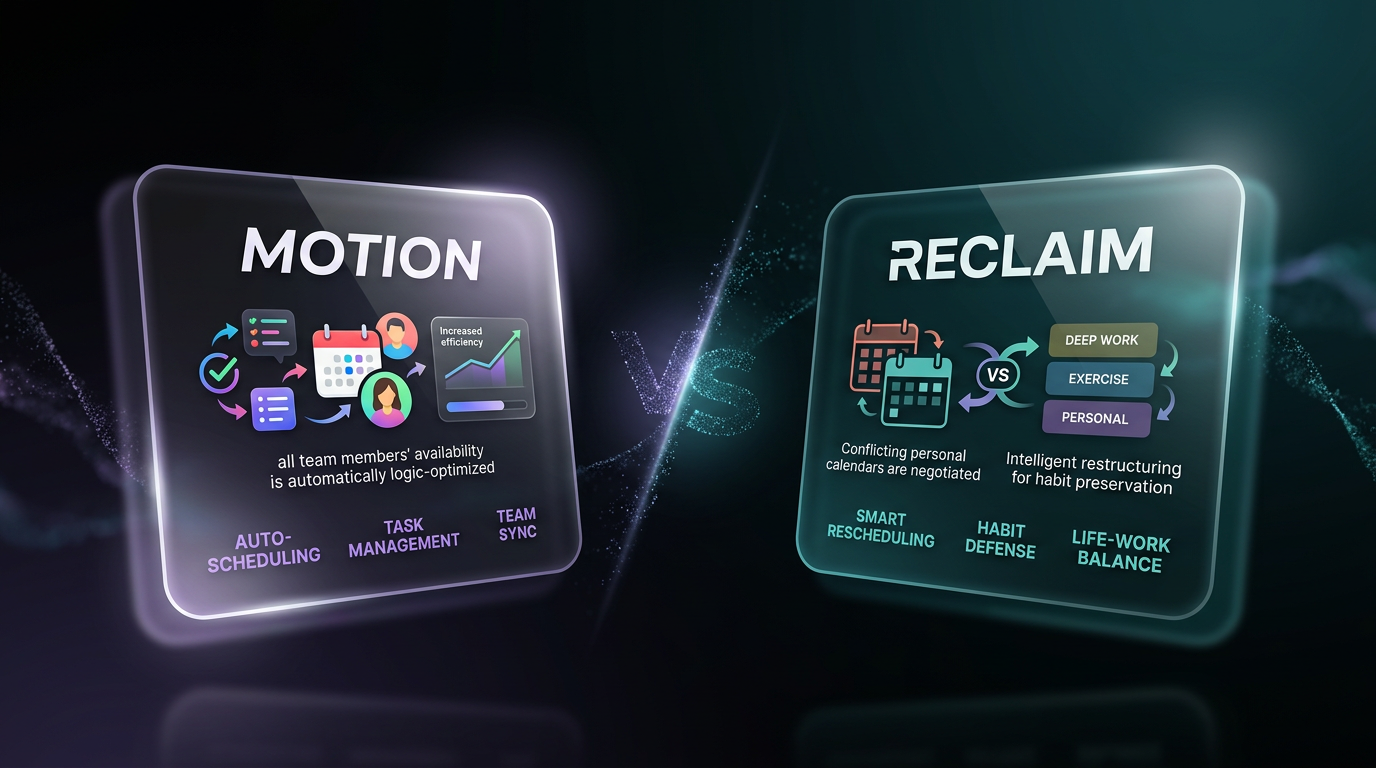
Motion sells itself as an all-in-one solution. It combines a task manager, a project management system, and an AI scheduler into a single, fairly complex interface. You create tasks, group them into projects, assign priorities and deadlines, and Motion’s AI dutifully arranges them on your calendar.
If a meeting pops up, Motion reshuffles your tasks. If you run behind, it recalculates. In theory, it’s a dynamic plan that adapts to the chaos of your day.
The friction is in the input. Motion needs to be fed. It needs you to constantly define what you’re working on, how long it will take, and how important it is. It’s a powerful to-do list with a scheduling engine bolted on. But it is, at its core, another system you have to diligently maintain. For founders and operators juggling a dozen streams of work, it can start to feel like a second job.
## Reclaim's Approach: The Time Defender
Reclaim has a different focus. It’s less of a project manager and more of a smart calendar assistant. Its primary strength lies in defending time for the things you want to do. You tell Reclaim, “I want to work out three times a week,” or “I need five hours of deep work for this project,” and it finds and blocks off that time.
It’s excellent at creating and maintaining habits. It has smart features for syncing personal and work calendars and for scheduling one-on-one meetings. It operates more quietly than Motion, focusing on time blocking and boundaries rather than granular task management.
The limitation is that it’s primarily defensive. It carves out the space, but it doesn’t do as much to help you manage the actual work within that space. It’s a traffic controller for your time, ensuring your priorities have a lane to drive in. It’s less concerned with what car you’re driving or where you’re ultimately going. It’s a key piece of the puzzle, but not the whole picture.
## The Flaw in the Motion vs Reclaim Debate
This brings us back to the central issue. The **Motion vs Reclaim** contest is a debate about which tool is better at scheduling the tasks you manually enter into it. It’s a competition between two different philosophies of micromanagement.
This entire framework is wrong. The goal shouldn’t be to become a master scheduler of your own work. The goal should be to eliminate that role entirely. Why are you spending precious time translating work into tasks, just to feed them into a machine that puts them on a calendar?
The next leap in productivity isn't about better scheduling. It's about ambient understanding. We’ve explored before how your tools create a [false sense of productivity](https://stayaware.ai) and why the quest for more focus often leads to [more administrative work](https://stayaware.ai). The solution isn't another dashboard. It's less intervention, not more.
## Aware Isn't a Calendar App. It's an Operating Layer.
We built Aware because we were tired of being task managers. Aware is not another app you have to manage. It's an ambient AI operating layer that works in the background of your existing tools.
It connects to your email, your Slack, and your calendar. It doesn't ask you to create tasks. It reads your conversations, understands context, and identifies the actual work that needs to be done.
An investor asks for your deck in an email. Aware sees it. You don’t create a task. Aware knows a follow-up is required if you don't send it, and it knows when you have. Your co-founder asks you on Slack to review the new landing page copy. Aware sees it and understands the action item. You don't have to switch apps and type "Review landing page copy."
Aware surfaces these commitments at the right time, with all the necessary context attached. It doesn't clutter your calendar with a dozen small, speculative tasks. It presents the work when it needs your attention. It's a quiet, intelligent partner, not a demanding manager.
You're no longer translating. You're just doing.
It looks less like a complex project plan and more like a simple, actionable prompt. Notice how the context is summarized without you lifting a finger:
[Product screenshot showing a simple UI where an action item from an email is surfaced with the relevant context and a "Done" button, contrasting with the dense calendar views of other tools.]
The cognitive load of capturing, organizing, and scheduling is simply gone. That’s not an incremental improvement. It’s a categorical shift.
## So, What's the Real Answer?
If you are looking for **Motion AI alternatives** or **apps like Motion**, you're looking for another version of the same thing. They all ask you to be the central processing unit.
So, for the original question of **Motion vs Reclaim**: if you want a powerful, all-in-one system for manually managing projects and tasks on your calendar, Motion is for you. If you want a simpler, more elegant tool to defend time for your habits and priorities, Reclaim is a great choice. They are fine tools for the job they were designed to do.
But they were designed for the wrong job. They are solutions for people who have accepted that their work involves a significant amount of administrative self-management. We believe that is a bug, not a feature, of modern work.
The point isn't to get better at scheduling work. It's to do the work. The endless cycle of capturing, categorizing, and calendaring is a distraction. The whole **Motion vs Reclaim** search is a symptom of a problem that shouldn't exist. You deserve a system that works for you, not one that gives you more work to do.
The best way to understand the difference is to feel it. Stop managing your tasks and let them be handled. When you’re ready to get off the hamster wheel of task management and experience an entirely different way of working, you can [try Aware and see what ‘handled’ actually feels like](https://stayaware.ai/trial/handled).