Notification Fatigue Is a Workflow Problem, Not a Willpower One
The constant ping of notifications is not just an annoyance; it is a structural failure. We treat **notification fatigue** as a personal failing—a lack of focus, a deficit of willpower. The truth…
By The Aware Engineering Team
# Notification Fatigue Is a Workflow Problem, Not a Willpower One
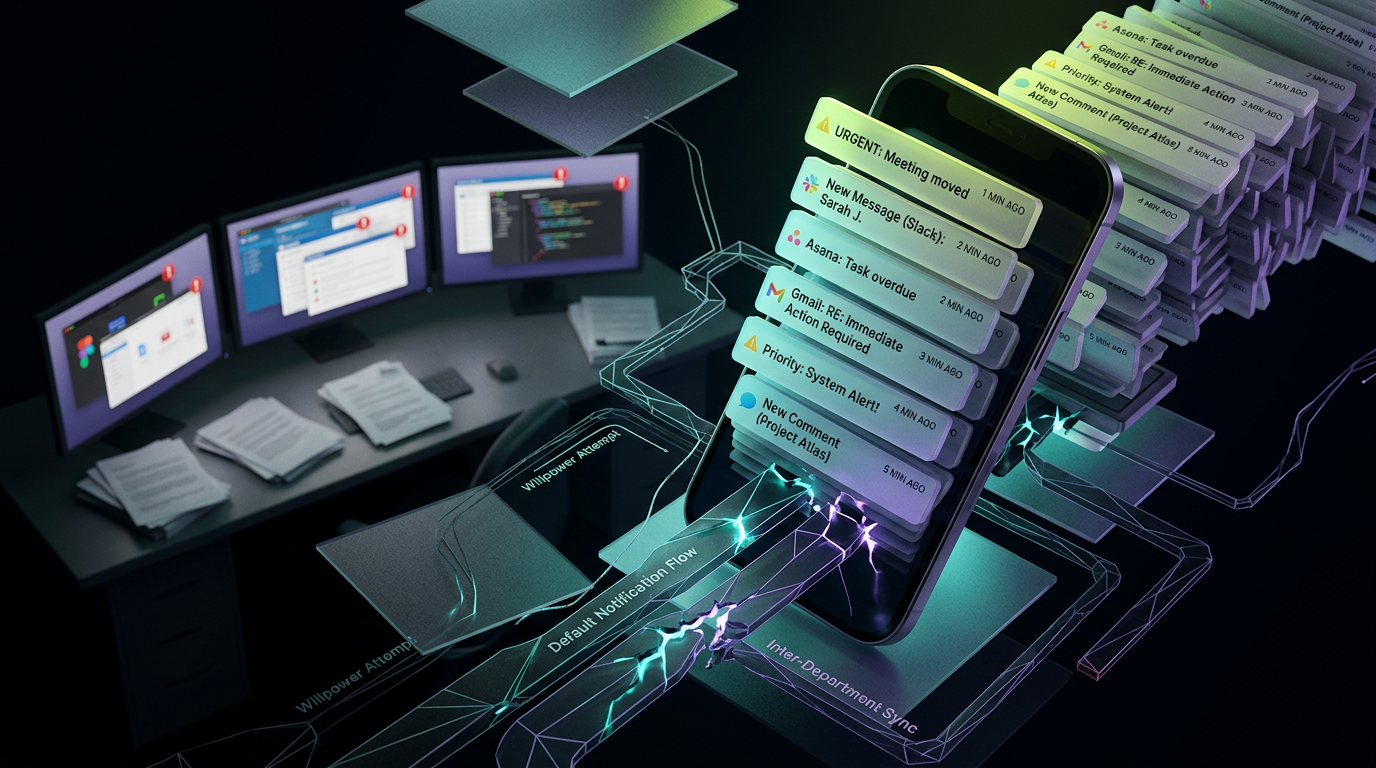
The constant ping of notifications is not just an annoyance; it is a structural failure. We treat **notification fatigue** as a personal failing—a lack of focus, a deficit of willpower. The truth is your tools are designed to cause it, and no amount of self-discipline can fix a system that is fundamentally broken. The problem is in your workflow, not in your character.
## The myth of the focused individual
Our work culture loves the story of the lone genius, locked away and engaged in deep, uninterrupted thought. We're told to cultivate focus, to build mental fortitude, to be more disciplined. Then we're handed a suite of tools engineered to do the exact opposite.
Your average workday is a firehose of inputs. Slack messages, email chains, project management updates, calendar alerts, and a dozen other apps all compete for a slice of your attention. This isn't an accident. It's the business model.
**Notification anxiety** is the only rational response to this environment. The fear of missing something critical is real because your tools mix genuinely urgent requests with absolute noise. You’re conditioned to check everything because you have no reliable way to tell what actually matters. The system is designed to keep you perpetually off-balance.
## Your tools are not on your side
Every app on your screen wants to be the center of your world. Their key metrics are based on engagement, and the easiest way to drive engagement is to send a notification. The red dot is a tiny, persistent demand for your time, a digital tap on the shoulder that you can’t ignore.
The standard advice is to “just turn them off.” This is a simplistic answer to a complex problem. Going dark means you risk missing a legitimate emergency—a server outage, an urgent client request, a critical question from your team. You trade the noise of **notification overload** for the anxiety of being out of the loop.
> Telling someone to 'just turn off notifications' is like telling a firefighter to ignore their radio. The problem isn't the signal; it's the static.
This all-or-nothing approach fails because it doesn't address the root cause. You need the information. You just don't need it all, right now, delivered with the same false urgency.
## The real cost of context switching
Every time a notification pulls you out of a task, you pay a tax. It’s not just the few seconds it takes to read the alert; it’s the cognitive cost of disengaging from your current context, processing a new one, and then attempting to settle back into what you were doing. This process is anything but free.
Research on context switching shows it has steep and measurable costs. The constant splintering of your attention doesn’t just feel bad; it actively degrades the quality of your work.
These costs aren't just personal inconveniences; they are direct business expenses:
* **Time lost:** Studies suggest it can take over 20 minutes to fully regain focus after a significant interruption. Compounded over a day, this is a massive drain on productivity.
* **Increased cognitive load:** Juggling multiple streams of information exhausts your working memory, leaving you with less mental capacity for complex problem-solving.
* **Higher error rates:** Distracted work is sloppy work. When your focus is fragmented, you are far more likely to make mistakes.
* **Shallow thinking:** Deep work requires sustained, uninterrupted concentration. When you are constantly being pulled to the surface, you never get the chance to think through hard problems.
The constant interruptions actively prevent the kind of thinking that creates real value. Your tools promise productivity while delivering a state of perpetual distraction.
## Fixing notification fatigue at the source
The only way to solve this problem is to stop treating it as a personal failing and start treating it as a systems engineering challenge. You don't need more willpower; you need a better workflow. The solution isn't to eliminate notifications but to introduce an intelligent filter between you and the noise.
This requires rethinking how information flows to you. Instead of letting every app shout at you whenever it wants, you can design a system that serves information on your terms.
It starts with a few deliberate steps:
1. **Audit your inputs.** Make a list of every single application, service, and channel that has permission to notify you. Be brutally honest. This includes email, team chat, project managers, CRM alerts, and social media. Seeing it all in one place is often a sobering experience.
2. **Categorize by intent.** Not all pings are created equal, yet your phone treats them as if they are. The core task is to separate the signal from the noise. Group alerts into categories like `Urgent/Action Required`, `Question/Needs Response`, `FYI/Informational`, and `Bot/Automated`.
3. **Batch the non-urgent.** Most notifications are informational. They don't require an immediate reaction. The key is to **reduce notifications** in real-time by bundling these low-priority updates. Designate specific times—say, twice a day—to review a summarized digest of everything that is not on fire.
4. **Enforce new rules of engagement.** A better workflow requires clear protocols, especially for teams. Define where different types of communication belong. For example: true emergencies are a direct message or phone call. Project-specific questions live in the project management tool's comments. General chatter stays in a dedicated `#random` channel. This creates predictability.
Implementing this manually is possible, but it’s fragile. It requires immense, ongoing discipline from you and your entire team. It's creating another job for yourself: the full-time manager of your own attention.
## An operating layer for your attention
The manual system is a good start, but it’s a brute-force solution. The real fix isn't another set of rules to follow or another dashboard to check. The real fix is an intelligent layer that automates this entire process.
Imagine a system that sits quietly between you and the chaos. An ambient layer that connects to your tools, reads the firehose of information for you, and understands the content and intent of every message.
This layer can see that a Slack message from your biggest client containing the word "urgent" needs to be surfaced immediately. It also sees that the notification from your CI/CD pipeline is just a routine success message and can be bundled into a summary for later. It can differentiate a direct question from a team member from a general announcement that is merely an FYI.
This isn't about another inbox. It’s about building a calm, intelligent buffer. A system that summarizes, prioritizes, and presents what matters, when it matters, without demanding your constant attention. It gives you long, uninterrupted blocks of time to do actual work. This is what *Aware* does. It’s an AI operating layer for your focus.
You can’t win the war against **notification fatigue** by trying harder. The game is rigged. The only way to win is to change the game—to install a system that finally puts your tools to work for you, not the other way around. Stop blaming yourself for the failures baked into modern software.
The principles in this post are not a theoretical wish list. They are the foundation of *Aware*, an ambient AI layer that handles the noise so you can handle the work. You can explore what a truly focused workflow feels like by starting a free trial.