The Post-App World: Where Software Stops Looking Like Software
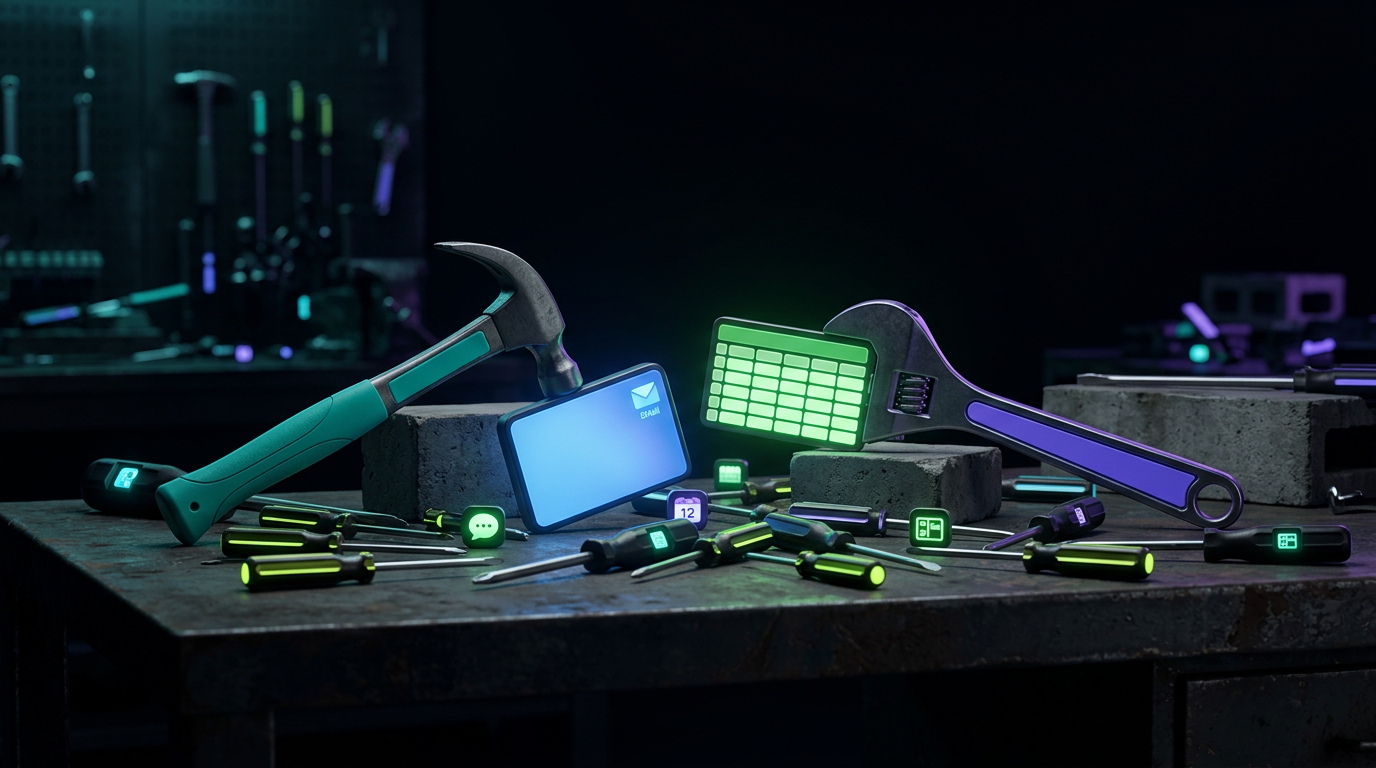
Your computer is a disorganized garage of single-purpose tools. You have a hammer for email, a specific wrench for spreadsheets, and a dozen different screwdrivers for chats, notes, and project boards. This…
By The Aware Engineering Team
# The Post-App World: Where Software Stops Looking Like Software
Your computer is a disorganized garage of single-purpose tools. You have a hammer for email, a specific wrench for spreadsheets, and a dozen different screwdrivers for chats, notes, and project boards. This isn't an efficient workshop; it's a mess. The promise of software was to make work easier, but for most of us, the work has become managing the software.
This chaos is the peak of the app-centric era. But it’s an endpoint, not the future. We’re entering the **post app world**, where the organizing principle of your work is you, not the application you happen to have open.
## The great unbundling is over
For a decade, the dominant trend in software was unbundling. The suite was dead, and in its place came a thousand hyper-specialized apps, each promising to do one thing ten times better. There was a brief, shining moment where this felt like progress.
It wasn’t. It was a fragmentation bomb. The "one thing" each app did well was a tiny sliver of a larger workflow, forcing you to stitch together a dozen tools just to complete a single project. The average knowledge worker now juggles tools for:
* Internal team chat
* External email
* Document creation and storage
* Spreadsheets and data analysis
* Project and task management
* Video conferencing
* Calendar scheduling
* Customer relationship management
* Internal wikis or knowledge bases
Each tool has its own login, its own UI, its own notification system, and its own monthly subscription. This isn't a streamlined stack; it's a tax on your attention. The "app for that" philosophy solved a thousand small problems by creating one massive one: terminal context-switching.
## Your attention is the platform
The fundamental flaw of the app model is that it forces you to think like a database. To find a piece of information, you first have to remember which app you stored it in. To complete a task, you have to mentally map out which three apps you need to open and in what order.
This is backward. The software should adapt to you, not the other way around. In a more intelligent model, your *intent* is the starting point. The platform is your flow of work, and the tools are just resources the platform can use on your behalf.
> The job of software is to get out of your way, not give you another place to go.
This requires a new layer in the stack. An ambient, AI-native layer that sits above the fragmented apps you already use. It understands your context, connects to your tools, and lets you operate from a single surface. You stop opening apps. You start stating outcomes.
## What the post app world feels like
Moving beyond apps isn't about replacing every tool you use. It's about obscuring their seams. The *future of apps* is not needing to see them at all.
This isn't a single, monolithic "super app." It's a quieter, more integrated way of working, driven by a few core principles.
### Intent, not interaction
Instead of clicking through a graphical user interface, you simply express what you want to accomplish in plain language.
An old workflow for scheduling a meeting might look like this: Open your calendar. Find an open slot. Open your email. Type out a message to a colleague proposing three different times. Wait for a reply. Go back to your calendar. Create the event. Add the video link. Invite the attendee.
The new workflow is one sentence: "Find 30 minutes with Sarah next week to review the Q3 deck." The system handles the rest. This shift from manual interaction to stated intent is the core of the **post app world**. It’s the difference between being a pilot and being a passenger who just names their destination.
### Context is king
A truly intelligent system doesn't make you start from scratch on every request. It maintains context. It knows who "Sarah" is because you've emailed her before. It knows what the "Q3 deck" is because it's a file in your project folder. It knows your scheduling preferences and the working hours of your colleagues.
This persistent context is what makes the experience feel less like a computer and more like a competent assistant. It doesn't need a detailed manifest for every trip because it has seen your travel history. It anticipates needs instead of just reacting to commands.
### A unified surface
When you remove the need to constantly switch between app windows, the desktop itself can change. The grid of icons becomes less important. The primary interface for your work might be a single, elegant command bar, a conversational thread, or a proactive feed that brings you what you need before you ask.
The goal is to have one place to capture, delegate, and find anything, without needing to care where the underlying data lives.
## The death of the dashboard
Dashboards are a monument to failed software design. They present a sea of charts and numbers and expect *you* to do the work of synthesis. A dashboard is an admission by the software that it can't figure out what's important, so it’s showing you everything.
*AI replacing apps* doesn't mean you won't use a CRM or a project manager anymore. It means you won't have to stare at their dashboards to know what's going on. The intelligence layer does the monitoring for you and delivers insights, not raw data.
Consider the difference in tracking a project's health.
1. **The Old Way (Dashboard):** You open your project management tool. You look at the burndown chart. You click over to the task list and filter for "blocked" or "overdue." You cross-reference that with the project calendar to see if key milestones are at risk. You then open your team chat to ask for updates. You are the human processor.
2. **The New Way (Insight):** You get a single, proactive notification: "Project Alpha is at risk of missing its Tuesday deadline. Two key tasks assigned to Mark are stalled, and he's OOO tomorrow. Want me to ping a teammate to see who can take them over?"
The first way forces you to perform analysis. The second way delivers the completed analysis and proposes a solution. One is work. The other is leverage.
## This isn't science fiction
It’s easy to dismiss this vision as futuristic hype. But the plumbing is already in place. Large language models provide the natural language interface. Ubiquitous APIs provide the connective tissue to existing apps. A mature cloud infrastructure provides the power.
The primary obstacle to the **post app world** hasn't been technology; it's been imagination. Most companies are still trying to cram AI into the old app-centric metaphor, creating "smarter" buttons within the same cluttered interfaces. They're building faster horses, not inventing the car. The real opportunity is to rethink the interface paradigm entirely.
It requires a different philosophy—one that prioritizes calm, focus, and human attention over engagement metrics and feature creep. It means building software that aims to be invisible.
The shift is already underway. The tools that win the next decade will be the ones that help you escape the prison of a thousand tabs and let you get back to the actual work. They won't ask you to log in; they'll simply be there, ready for your next intent.
The concepts we're describing aren't theoretical. They’re the foundation of *Aware*, an operating layer built from the ground up for this new reality. If you’re tired of managing software and want your software to start managing your work, you can see what it feels like to have it all handled.