Proactive vs. Reactive AI: One Is the Whole Point
Almost everything you call "AI" today is a glorified search engine with better syntax. It’s a powerful tool, no question, but it’s fundamentally passive. It waits for you to ask it a…
By The Aware Engineering Team
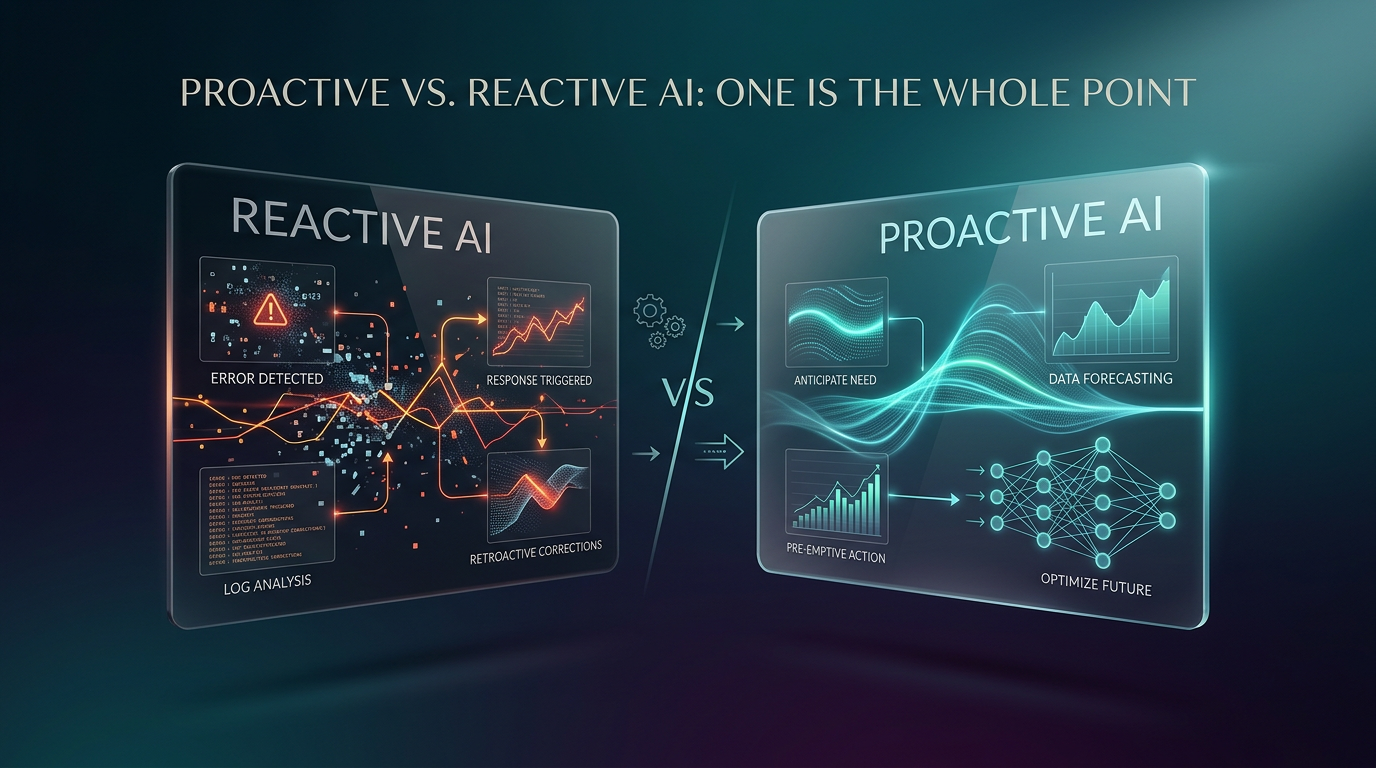
# Proactive vs. Reactive AI: One Is the Whole Point
Almost everything you call "AI" today is a glorified search engine with better syntax. It’s a powerful tool, no question, but it’s fundamentally passive. It waits for you to ask it a question, give it a task, or feed it a prompt. This is the reactive model, and while useful, it is not the paradigm shift you were promised. It’s just a faster way to do the work you already knew you had to do.
The real promise lies in a different direction entirely. It lies in **proactive ai**.
## The tyranny of the prompt box
The current generation of AI tools operates on a simple command-response loop. You think of something, you open a chat window, you type a command, and you get a response.
This model places the entire cognitive burden on you. You have to know what to ask. You have to remember to ask it. You have to context-switch away from what you’re doing, formulate the perfect prompt, and then integrate the answer back into your workflow. The AI isn't saving you from the mental load of organizing your work; it's just helping you execute a task you’ve already organized in your head.
It’s like having an executive assistant who stands silently in the corner of your office until you tap them on the shoulder and give them a highly specific, step-by-step instruction. They will never anticipate a need. They will never connect two different conversations. They will never remind you about something you’ve forgotten. They are a tool, and a tool only works when you pick it up.
## What is proactive ai?
A proactive AI doesn't wait for the prompt. It acts first.
This is an AI that operates in the background of your work, understanding context and synthesizing information across your different applications. It watches for patterns, flags commitments, and connects disparate threads of information without being asked. It anticipates your needs and surfaces suggestions, draft actions, and critical insights before you even realize you need them.
This changes the fundamental relationship you have with the technology. Instead of you serving the AI with prompts, the AI serves you with opportunities.
A proactive AI assistant is constantly working for you, looking for chances to:
* Connect an email from a new contact to a person you met three weeks ago.
* Surface a forgotten to-do from a call transcript.
* Draft a follow-up message based on the action items of a meeting that just ended.
* Flag a scheduling conflict between a new invite and a personal calendar event.
* Remind you of a promise you made in a message last Tuesday.
It’s not about generating text on command. It’s about creating leverage out of the ambient information of your workday.
## The anatomy of proactivity
A reactive chatbot can be built in a weekend. A truly proactive system requires a more fundamental architecture. It isn't a feature; it is the entire point of the product.
### Ambient awareness
To anticipate, the AI must first be aware. A proactive system needs secure, private access to the context layer of your work—your meetings, emails, and messages. Not to monitor you, but to build a private, local model of your commitments, relationships, and projects. It is an AI that is *present* in your work, not one you have to summon on demand.
### Synthesis over retrieval
Reactive AI is excellent at information retrieval. You ask for a summary of a document, and it gives you one. Proactive AI is built for synthesis. It doesn’t just look at one document; it sees the connection between a calendar invite, the transcript of the resulting call, and the follow-up email chain. It then synthesizes these disparate pieces of data into a single, actionable insight or suggestion.
Retrieval finds the needle in the haystack. Synthesis sees the pattern in the hay.
### Suggested actions, not just answers
The output of a proactive system isn't just a block of text. The output is a proposed next step. It’s an action you can take with a single click.
> A tool waits to be picked up. A partner taps you on the shoulder and says, "You might want to see this." Most of today's AI is just a very fancy hammer.
Instead of writing, "John said he would send the file by EOD Friday," a proactive AI presents a button: "Create task: Follow up with John on file by Friday?" This subtle shift from presenting information to presenting an action is the difference between a library and an assistant.
## The problem of trust and agency
The notion of an AI "acting on its own" can be unsettling. And it should be. The goal of proactivity isn't to create a rogue agent that sends emails or deletes files without your knowledge. Autonomous action is a bug, not a feature.
A well-designed proactive AI assistant operates with a human in the loop. It suggests, it drafts, it proposes. You approve, you edit, you send. The AI acts as a preparer, doing the 80% of the work to tee up a decision, but the final 20%—the decision itself—always rests with you.
There's a ladder of healthy proactivity, and the user is always on the top rung.
1. **Notification:** The system simply surfaces a fact. "FYI, your 2pm meeting has been rescheduled."
2. **Insight:** It connects facts to draw a conclusion. "The person in your next meeting works at the same company as a lead you spoke with last year."
3. **Suggested Action:** It proposes a concrete next step. "Would you like to draft a follow-up email to the team from your last call?"
4. **Pre-populated Action:** It does the work upfront. "Here is a drafted follow-up email based on the call. Review and send?"
At every stage, the AI defers to you. It surfaces opportunity, but you retain full agency. It does the work of remembering and preparing, freeing you up to do the work of thinking and deciding.
## From reactive tool to proactive partner
The industry’s obsession with reactive, prompt-driven AI is a failure of imagination. It refines an old process—seeking information—but doesn't introduce a new one. It makes the user a better prompter, a better question-asker. It does not, however, fundamentally reduce the amount of work on their plate.
The real leap forward isn't in helping you answer your questions faster. It’s in reducing the number of questions you ever have to ask. It's about offloading the cognitive overhead of tracking, remembering, and connecting the dots. This is the core difference between a clever tool and a genuine partner. One is reactive. The other is proactive.
The world doesn't need another chatbot. It needs an operating layer that works for you, anticipates your needs, and handles the administrivia of your life so you can focus on the work that matters. The shift from reactive commands to **proactive ai** is the entire point.
This is what we've built. See how a truly proactive AI partner works by trying *Aware* for free.