Saner AI vs Aware: Two Different Theories of How AI Should Help You
The promise of an AI assistant is that it will do work for you; the reality is that most just give you a new inbox to manage. This creates a fundamental divide…
By Kris Groves
# Saner AI vs Aware: Two Different Theories of How AI Should Help You
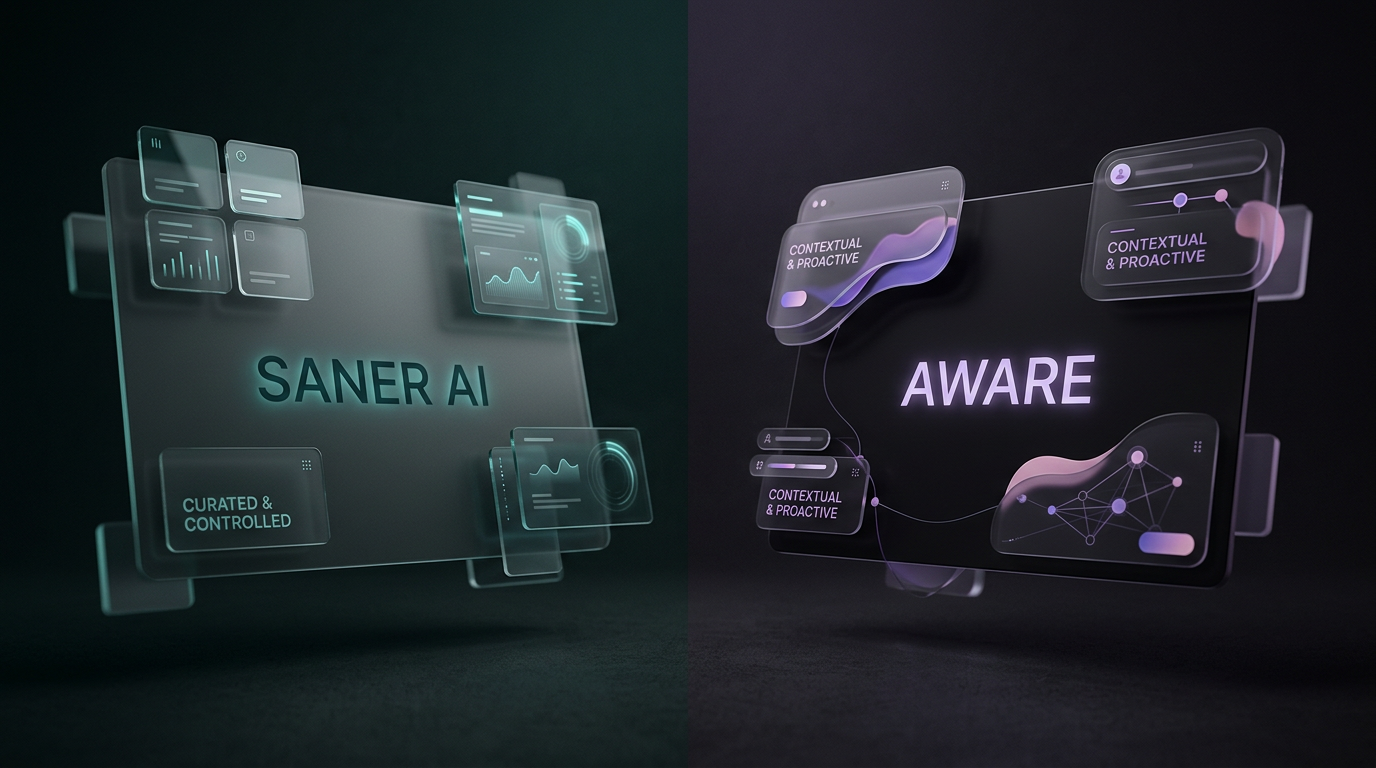
The promise of an AI assistant is that it will do work for you; the reality is that most just give you a new inbox to manage. This creates a fundamental divide in how AI tools approach productivity. Looking at a *Saner AI vs Aware* comparison reveals two deeply different theories about what "help" actually means.
One theory says AI should give you sharper tools to manually sort through the digital noise. The other says AI should make the noise irrelevant by handling the important bits for you, automatically.
## An inbox vs. an operating layer
The most immediate difference is what the tools *are*. *Saner*, at its core, is a well-designed email client with AI features. It aims to make the Sisyphean task of processing your inbox feel less punishing. You live inside *Saner* to deal with your email, triage messages, and turn them into tasks.
*Aware*, by contrast, is not a destination application you live inside. It is an ambient operating layer that works across your existing tools. It connects to your calendar, your email, your Slack, your meeting transcripts. It doesn't replace them; it understands them. **Aware is a background intelligence**, not a foreground task.
This distinction is everything. One is a better bucket for catching the flood. The other works upstream to divert the water you don't need and bottle the water you do.
## Capturing notes vs. understanding context
The *Saner* workflow is active. You see an email, a thought, or a task, and you "capture" it. You tell the system what's important. It provides a clean, fast way to shuttle information from your inbox to a structured list. This is a massive improvement over starring emails or using a separate to-do app, but the cognitive load is still on you. You are the chief curator of your own digital life.
*Aware* is passive. It builds context by observing your work. It listens to your Zoom calls. It reads your Slack DMs. It sees your calendar invites. It doesn't need you to "capture" an action item from a meeting because it was already there, listening. It knows who said what, what was promised, and what the deadline is, all without you lifting a finger.
> The goal isn't to get better at documenting your work. The goal is to get your work done with less documentation.
This is the central philosophical split. Should AI make it easier for you to do administrative work, or should AI do the administrative work for you? We have a strong opinion on the matter.
## How a task gets done
A good way to understand the difference is to trace the lifecycle of a single action item, from inception to completion.
Let's say a client emails you asking for a proposal by Friday.
#### The *Saner* workflow
1. Open the *Saner* app to check your email.
2. Read the client's message.
3. Use a shortcut or command to "capture" this email as a task.
4. The AI might help you title it, like "Send proposal to Client X."
5. You then manually add a due date for Friday and perhaps add a reminder.
6. The task now lives in your *Saner* to-do list, which you manage alongside your email.
It's a clean, efficient system for manual processing.
#### The *Aware* workflow
1. The client's email lands in your regular Gmail or Outlook inbox. You might not even see it immediately.
2. *Aware*, connected to your email account, parses the message in the background. It recognizes the language of a request ("can you send me"), an object ("the proposal"), and a deadline ("by Friday").
3. A task is automatically drafted and appears in your *Aware* inbox. It reads: "Send proposal to Client X by EOD Friday."
4. You can accept it, delegate it, or dismiss it with a click. It requires your intent, not your labor.
One flow helps you document the work that needs doing. The other simply tells you what work has been created, with the documentation already handled.
## Saner AI vs Aware on collaboration
Productivity isn't a solo sport. For founders, freelancers, and operators, work happens in teams, with clients, and across organizations. How an AI productivity assistant handles this reality is critical.
*Saner* is fundamentally a single-player tool. It streamlines *your* inbox and *your* tasks. While you can forward emails and delegate in a traditional sense, the AI's intelligence is focused on you. It doesn't have a native understanding of your team's projects or who is responsible for what, beyond what you manually input.
*Aware* is built for collaboration from the ground up because its context is shared.
* **Shared Reality:** Because *Aware* ingests information from shared spaces like Slack channels and group meetings, it builds a model of the project that both you and your teammates share. It knows Sarah is handling the design mockups because she said so in the project kickoff call.
* **Intelligent Delegation:** When a task appears that could belong to multiple people, *Aware* can suggest the most likely owner based on past conversations and responsibilities. Delegating becomes a one-click confirmation, not a separate email or Slack message.
* **Project Memory:** *Aware* serves as a passive, collective memory for your team. Anyone can ask "What did we decide about the Q3 budget?" and get a direct answer sourced from the actual meeting transcript, without having to find the recording or bug a colleague.
This transforms AI from a personal secretary into a team's chief of staff.
## So, what are you looking for?
When looking for *Saner* alternatives or a better *ai productivity assistant* in general, the choice comes down to what problem you’re trying to solve. There is no right or wrong answer, only a better or worse fit for your needs.
If your primary pain point is an overwhelming email inbox and you want a more focused, beautiful, and intelligent interface for processing it all, *Saner* is a compelling tool. It's a significant upgrade over a standard Gmail tab. It is a premium shovel for the digital trenches.
But if your goal is to get out of the trenches entirely—if you believe that the job of AI is to automate the administrative busywork of tracking commitments, remembering details, and connecting the dots—then you are looking for a different class of tool. You are looking for a system that reduces the amount of processing you have to do in the first place.
This is the core of the *Saner AI vs Aware* distinction. One helps you manage the work. The other does the managing for you.
We built *Aware* on the conviction that your focus is a finite resource. It shouldn't be spent on inbox triage, manual note-taking, or remembering who promised to do what. It should be spent on the actual work.
You can try Aware for free and see what ‘handled’ actually feels like.