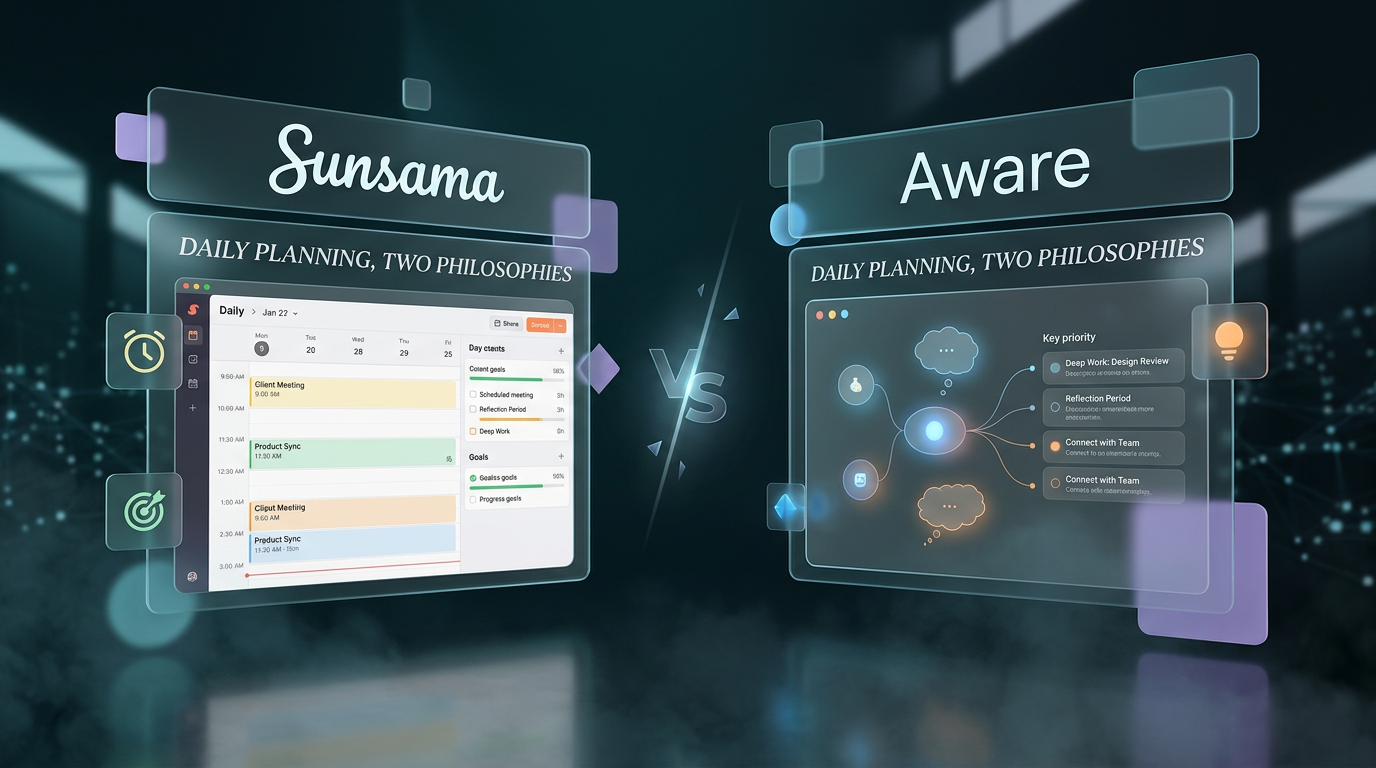
Sunsama vs Aware: Daily Planning, Two Philosophies
Choosing a daily planning app feels like choosing a personality
By Kris Groves
# Sunsama vs Aware: Daily Planning, Two Philosophies
Choosing a daily planning app feels like choosing a personality.
It’s not just a feature list; it’s a commitment to a certain philosophy of work. The debate of *Sunsama vs Aware* isn't a simple shoot-out between two calendars. It's a conflict between two fundamentally different ideas about what it means to be in control of your day.
## The ritual vs the reality
*Sunsama* is built around a ritual. The day begins with a quiet, meditative process: open the app, review your calendars, pull in relevant emails, and manually construct a beautiful, time-boxed plan. It’s a deliberate act of imposing order on chaos before the day truly begins.
For many, this is calming. It’s a moment of control.
*Aware* operates on a different assumption: the plan you make at 8 AM is a beautiful lie that will be dismantled by 9:30 AM. Reality is dynamic, chaotic, and arrives via a dozen different inboxes. Our philosophy is that a tool should reflect this reality, not ask you to pretend it doesn't exist.
## Control via manual entry
*Sunsama* gives you control by forcing you to touch everything. An email becomes a task only when you drag it into your list. A thought becomes an action item only when you type it out. You estimate the time for each item, assigning it a specific slot in your day. This is mindfulness by way of data entry.
The entire system is an exercise in manual curation. You are the librarian of your own focus, meticulously cataloging every commitment. This is its core strength, and its core tax. The overhead is constant. You are the system administrator of your day, and the job is never done. This friction is often what leads people to look for *Sunsama alternatives*.
> If your primary job is managing your productivity tool, the tool has failed.
It's a simple, brutal truth. Your energy should be spent on the work itself, not the meta-work of organizing the work.
## Control via ambient capture
*Aware* offers control through a different mechanism: comprehensive, ambient capture. It doesn't ask you to perform a morning ritual of data entry because it's been capturing your work reality all along. Promises made in email, requests dropped in Slack, and action items from a Zoom call are ingested and surfaced for you automatically.
Your "inbox" in *Aware* isn't a curated list of things you chose to add. It’s a complete, unvarnished reflection of your actual commitments. The control here isn't in building the perfect plan from scratch. It's in having a truly complete picture from which to make high-leverage decisions. You graduate from being a data entry clerk to being an executive.
## A closer look at Sunsama vs Aware
The philosophical gap becomes clearer when you map out the day-to-day workflow. One is a loop of manual maintenance; the other is a system of automated support.
### The daily workflow
In *Sunsama*, the workflow is a ritualized loop. It involves opening the app, connecting your various inputs, manually curating your task list, time-blocking your day, and then trying to stick to the plan. New items that arrive throughout the day must be manually triaged and dragged into the system to keep it current.
In *Aware*, the workflow is one of triage and execution. You open *Aware* to see what has already been captured on your behalf. Your job is not to build the list, but to prioritize it. You make decisions from a position of total information, acting on what's most important, while *Aware* continues to work in the background, ensuring nothing is missed.
### Handling interruptions
Interruptions are where the two models diverge most sharply. An urgent Slack message in the *Sunsama* world requires you to break your flow, switch context to the *Sunsama* app, and manually log the new task to maintain your plan's integrity. You serve the system.
In the *Aware* world, that same Slack message is captured automatically. It lands in your *Aware* inbox without you doing anything. The system captured the interruption so you didn't have to. You can deal with it when you're ready, at a natural break point. The system serves you.
## Where the philosophies diverge
At its core, this is a question of who the tool is built for. *Sunsama* is an exceptional tool for those whose days can be neatly blocked and planned—the consultant with discrete project blocks, the writer with dedicated drafting time. It’s for people who can realistically build a fortress around their schedule.
*Aware* is built for the operator, the founder, the executive—anyone whose primary role is to react, triage, and decide. It’s for people whose days are defined by inbound velocity.
To put it more directly:
* **Sunsama fosters calm through manual ritual.** Its integrations are designed for you to pull tasks into your sanctuary.
* **Sunsama excels at time-tracking and capacity planning.** Because you manually estimate everything, you get clear data on your planned vs. actual time.
* **Sunsama is a fortress.** You build the walls, and you guard the gate.
*Aware*, on the other hand, is a radar and navigation system.
1. **It automates the tedious.** The busywork of capturing tasks and commitments is simply handled. Forwarding emails to your task manager or copy-pasting Slack messages becomes an absurd, forgotten habit.
2. **It creates the single source of truth, automatically.** It surfaces not just the tasks you optimistically planned, but every single promise you've made, whether you realized it or not. **This is the complete picture of your obligations.**
3. **It prioritizes triage over planning.** It accepts that the most valuable skill in modern work isn't making a perfect plan, but making the right decision about the next priority from a messy, constantly changing list of options.
## The final question of your day
The *Sunsama vs Aware* choice ultimately boils down to a single question: do you want to spend your time building a perfect map, or do you want a GPS that navigates you through the territory as it actually is? One is a beautiful act of structured planning. The other is a powerful engine for real-time decision-making.
One asks you to build a perfect day. The other helps you win the day you actually get.
If you're tired of meticulously building plans only to see them fall apart by 10 AM, your work might need a different kind of support. Try Aware free — see what 'handled' actually feels like.