Where Did My Day Go? Use AI to Actually Answer the Question
It’s 5 PM, and you have no idea what you just did for eight hours
By The Aware AI Team
# Where Did My Day Go? Use AI to Actually Answer the Question
It’s 5 PM, and you have no idea what you just did for eight hours.
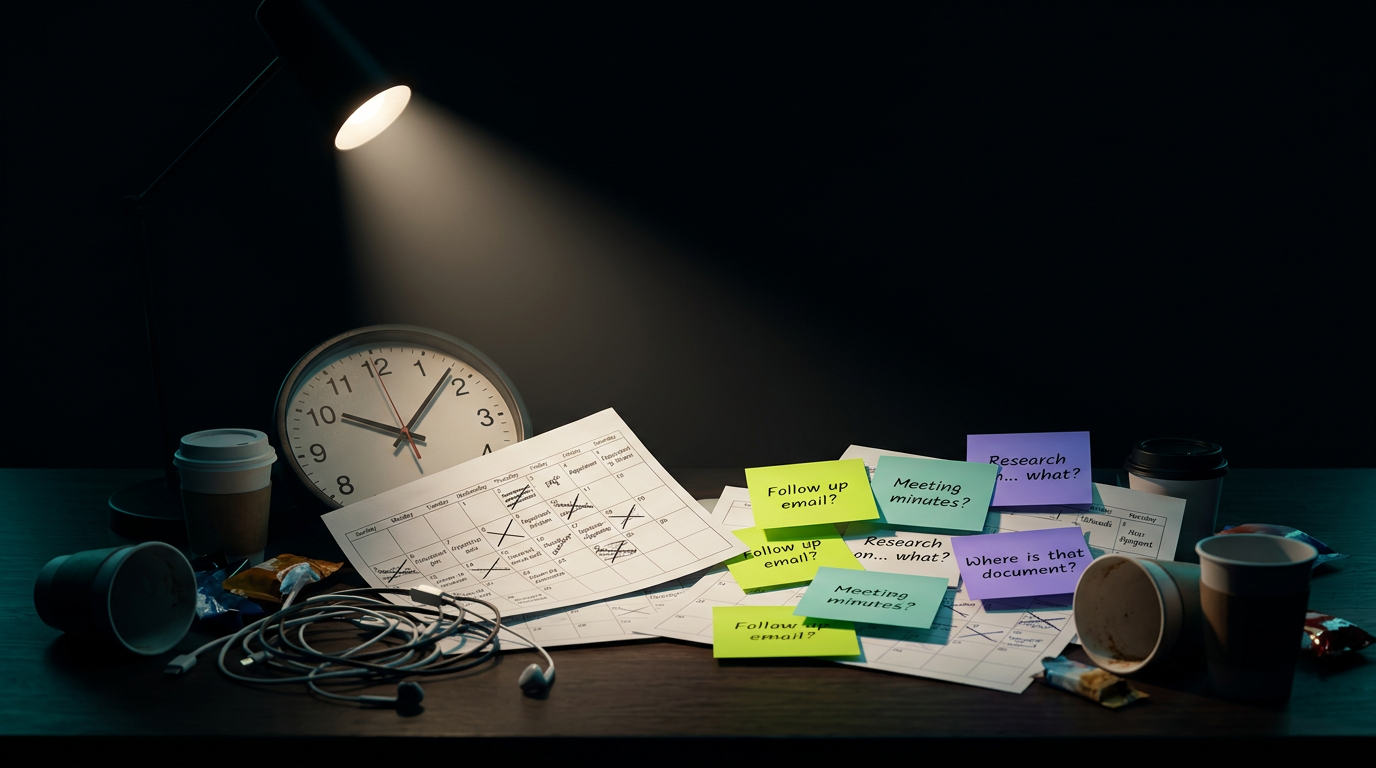
The calendar says you were productive, the task list has a few things crossed off, yet the feeling is one of frantic, unfocused motion. This is the core problem that productivity software promised to solve and never did. Getting genuine **ai time tracking insights** isn't about more charts; it's about getting a straight answer to a simple question.
## The absurdity of manual tracking
The tools meant to help you manage your time have become a tax on your time. You start a timer, forget it, then spend ten minutes at the end of the day reverse-engineering your activity from browser history and a foggy memory.
Manual time tracking is a second job you don't get paid for. It demands constant attention to categorize every action, switch between projects, and account for the five minutes you spent helping a colleague in Slack. The process is so tedious that the data it produces is often a work of fiction—a best-guess approximation you invent just to close out the entry and get on with your life.
This is the fundamental failure of the old model. A tool that requires you to stop working to log your work is a broken tool.
## Your calendar is a document of intent
Many people treat their calendar as a record of their day. It is not. It is a plan for your day, and plans rarely survive contact with reality.
That 30-minute sync call that bled into a 75-minute strategy session isn't accurately reflected. The two-hour "deep work" block you scheduled was actually 18 minutes of writing, interrupted by three urgent emails and a "quick question" on Slack that derailed you for half an hour. Your calendar is a list of good intentions, not a logbook of what actually happened. Relying on it for an accurate retrospective is a form of self-deception.
> A calendar tells you what you *hoped* to do. Your activity log tells you what you *actually* did. The space between them is where your day disappears.
The goal isn't just to see that divergence, but to understand it without any manual effort.
## Breaking free from surface-level data
Traditional app and website trackers offer data that feels insightful but ultimately isn't. Seeing that you spent three hours in Google Chrome and two hours in Slack tells you almost nothing.
Were you in Chrome researching a new market, or were you scrolling through Twitter? Were you in Slack coordinating a product launch, or were you arguing about the new logo? The application is not the activity. This kind of surface-level data creates reports that look official but are functionally useless for making better decisions. They quantify distraction without providing context.
This is the trap of vanity metrics for your own time. You get a pie chart of app usage that fails to answer the only question that matters: "Was I working on the right things?"
## True ai time tracking insights
The difference between a basic `time tracking ai` and an ambient intelligence layer is the understanding of context. It’s about moving from tracking applications to understanding purpose.
### From activity to intent
An operating layer like *Aware* doesn’t just see that you have a Google Doc open. It uses AI to understand the content and context of that document. It sees you’re working on the “Q3 Investor Update,” not just “time in Google Docs.” It connects that activity to the related Slack conversation and the email you sent to the finance team five minutes later.
This allows for a completely different level of analysis. Instead of a fragmented list of apps and websites, you get a cohesive narrative of your work, grouped automatically by project and task.
### From fragmentation to clarity
Manual tools force you to categorize your time into discrete, non-overlapping blocks. But work isn't like that. It's fluid, messy, and interconnected. A proper AI system understands this.
* **What old tools see:**
* 35 minutes in Google Chrome
* 20 minutes in Slack
* 15 minutes in Figma
* **What *Aware* sees:**
* 1 hour, 10 minutes spent on *Website Redesign - Phase 2*
This automatic grouping is the key. It requires zero input from you but delivers a completely accurate picture of where your focus and energy are actually going.
## Your ai daily summary, clarified
The end-of-day report shouldn't be a chore to read. It should be a clear, concise narrative that answers, "Where did my day go?" An effective **ai daily summary** isn't a data dump; it's a story.
Instead of a list of websites you visited, you should get a summary that reads like a human wrote it: "You started the day finalizing the pitch deck for the new client, then spent the late morning in back-to-back meetings. The afternoon was mostly spent tackling three major customer support tickets that came in."
A truly useful summary should always contain these elements:
1. **Major initiatives:** The 2-3 big projects or themes you touched during the day.
2. **Key tasks:** Specific, meaningful accomplishments within those initiatives.
3. **Significant context:** Important meetings, conversations, and decisions.
4. **Interruptions:** A clear signal of what pulled you away from your planned work.
This is the difference between raw data and actual intelligence.
## Putting the answer to work
Getting an honest look at your day isn't about productivity shame. It's about gaining leverage.
When you have a completely objective, automatically generated record of your day, you can finally see the patterns. You see the true cost of context switching. You see which tasks consistently take longer than you estimate. You see how much of your day is spent on reactive, unplanned work versus proactive, deep work.
This isn't about trying to optimize every second. It's about making sure your best hours are spent on your most important work. **The goal is not to become a machine; it's to get a machine to handle the accounting so you can be more human.** You get to stop guessing and start knowing.
Armed with genuine **ai time tracking insights**, you can adjust your next day. Maybe you block your calendar more realistically, turn off notifications during deep work, or delegate a category of tasks that’s consistently eating up your time. You can make strategic decisions, not just react to the chaos.
Stop reading about it. Try Aware free.